Friday, 5 November 2010

Call For Papers: History Idol -Leicester’s Got Talent!

In a quest to hear more about all the top class research going on at Leicester we’re launching our first ever New History Lab competition…OooOOooh!

Our ‘Speed Researching’ session showed us that’s there’s loads of great stuff going on amongst the post-grad community and we want to dedicate a whole lab session next semester to *Shiny New Research*.

But we can’t decide who to invite, so we’re going to let you do it!

If you are interested in sharing your work with the Lab next semester:

1) Please send us a 100 word abstract for a 15min presentation on any aspect of your research. Include, your topic area, why you’re interested in it, and your approach to the subject.

2) Give it an attention grabbing title -make us want to hear it!

3) We’ll gather them all in and then post the titles anonymously on the blog on the 26th November. We’ll all then have two weeks to vote on our favourite title on the New History Lab blog. The winners will be announced on the 9th December (the last Lab before Christmas).

To inspire you here’s a brief list of fabulous titles for papers I’ve heard recently:

‘Did I say Hairdressing? I Meant Astrophysics’: The 1970s as a turning point for women’s employment in science and technology

Totally Teapots: The Material Culture of Novelty Teapot Collecting

The price is right but the moments are sticky: Television, quiz and game shows, and popular culture

Gonna Rock Around the Clock (Tower) Tonight: Leicester, Sensuality and the Swinging Sixties

…fabulous examples of titles that make you want to hear more…Can’t wait to hear what you all come up with…Good luck!

Send your abstracts to Gill: [email protected]

New History Lab, 9 out of 10 cats agree it’s a wholly democratic organisation ;)

Our Man at the CCT: An Introduction (1)

Hello Labbers, Lab affiliates, Lab coats and Labradors,

My name's Mark, I used to be a masters student at Leicester and a full-time New History Lab groupie. Now I'm working as an intern in London and around the country with the Churches Conservation Trust and still clinging to my studenty past for dear life.


My posts this year will hopefully turn into a little series covering topics like the world of work in an office with a team rather than on a thesis by yourself, and visiting sites rather than visiting journal archives, the skills that can be transfered from studentdom to a 9-5 job, as well as the skills that studentdom definitely didn't prepare me for, the trials and tribulations as well as the fun and excitement of commuting to central London, and [hopefully] how to survive for a year in London without being paid for my work!

I should probably point out now that this will be an organic series as I only have a vague idea what the next year really has in store for me, but the idea is that it'll come in useful for students who're planning on following a similar path, giving them some clues as to what they might experience (or so they can work out how they could improve on my trailblazing example).

So, introductions:
The Churches Conservation Trust (CCT): The CCT was established in 1969 so that redundant churches (those that are no longer being used as places of worship), which have significant historical, aesthetic, archaeological, or community-centred aspects were maintained, conserved and made useful.

(go on, click it)
The Regeneration Taskforce, where I work, is the newest part of the Trust, which is specifically angled towards making redundant churches into ongoing concerns that make money for maintaining the church, as well as complementing the community surrounding the church. Some exciting and visual examples are:

St Paul's Church, Bristol
Was a grade 1 gothic church, now a circus school. AWESOME. Before the 7 year conservation scheme, the church had stood derelict and vandalised for 15 years. Since it opened its had c.14,000 visitors per year and keeps winning awards!

All Souls, BoltonAll Souls is a current project for the Regeneration Taskforce, its new use as a multi-functional community space will use the 'pods on stilts' method of creating buildings within the building, protecting as much of the historic fabric as possible. ALSO AWESOME. It has a strong focus on community involvement, as examplified through this page.

So, there's a little introduction to me and my new job, watch this space for updates, revelations, musings and hopefully a little bit of advice.

Ciao historistas!

(source for info and images: http://www.visitchurches.org.uk/)

Wednesday, 3 November 2010

Let's Go To San Fran Leicester

Young! and ALive! and Boppin! in LEICESTER IN THE 60s Tue 18:28 Dear LABBERS don’t just ask your parents - find out for yourselves what it was what it was like to be young and alive and boppin to the high school hop in Leicester in the Sixties. Just what exactly was a 'dance hall'? Why did Rock and Rollers wear 'drapes'? Surely you're not going to get on that thing in your best Hepworth's suit? But why was Hepworth's best? How did Mods dance? How much could you earn a working at Corah's and did you need a degree to earn it? Who did 'drugs' and how much did they do? Who did 'free love' and how much did they do? Were The Beatles better than The Stones? Were they both better than Herman's Hermits? Who played Leicester and where?

And on and on and on.

All these and more on a postcard please to NEW HISTORY LAB, Friday 430 pm @ 1 Salisbury Road.

Bring your questions and your memories.

And cakes.

Odd Sounds of the Sixties

For me there are three main strands in 1960s music:
  1. immensely popular guitar-driven pop songs by bands which now enjoy immense wealth and mythical status
  2. a much larger body of 'mundane' (although actually probably more interesting than #1) works which saw great contemporary success (think Cliff Richard, The Monkees, Englebert Humperdinck, etc)
  3. An influential and underappreciated avant-garde whose work was, in some cases, appropriated and watered-down by group 1
I'm not saying that bands like the Beatles or the Rolling Stones were not important, or that their work did not contain elements of originality. But in this blog post I want to restore the balance a bit, and give some attention to a small selection of some of the truly radical musical works that were produced in the 1960s.

The Zodiac : Cosmic Sounds (1967)

What is it?: 1967 proto-prog concept album based around the signs of the Zodiac
Impact factor: not much
Obscurity rating: so obscure that nobody is quite sure whether the album is called Cosmic Sounds and the band is called The Zodiac, or vice versa


György Ligeti, Poème Symphonique for 100 metronomes (1962)
What is it?: an 'event-score' by the Hungarian modernist composer György Ligeti in which 100 metronomes are left to tick to a halt
Impact factor: more than you might expect. Ligeti's compositions were used in the film 2001: a Space Odyssey, and his work is still admired and performed
Obscurity rating: as a well-known encyclopedia reports, the piece has only been performed a limited number of times 'due to the obvious difficulty of procuring such a large quantity of machines'


The Velvet Underground, Sister Ray (1968)
What is it?: 17m27s jam session which closes the album White Light/White Heat, foreshadowing the more egregious parts of Lou Reed's solo work
Impact factor: at the time almost none, but now an important part of the repertoire of a very important band
Obscurity rating: as above


Karlheinz Stockhausen, Kontakte (premiered 1960)
What is it?: extended electronic composition, developed at the Westdeutscher Rundfunk in 1958-60 by the composer of the Helicopter String Quartet.
Impact factor: substantial
Obscurity rating: often presented as the archetypal piece of dense avant-garde music, but nonetheless appreciated by a significant minority of Radio 3 listeners

Tuesday, 2 November 2010

Sex, drugs, and rock ‘n’ roll? Leicester in the 1960s: Manning it up!


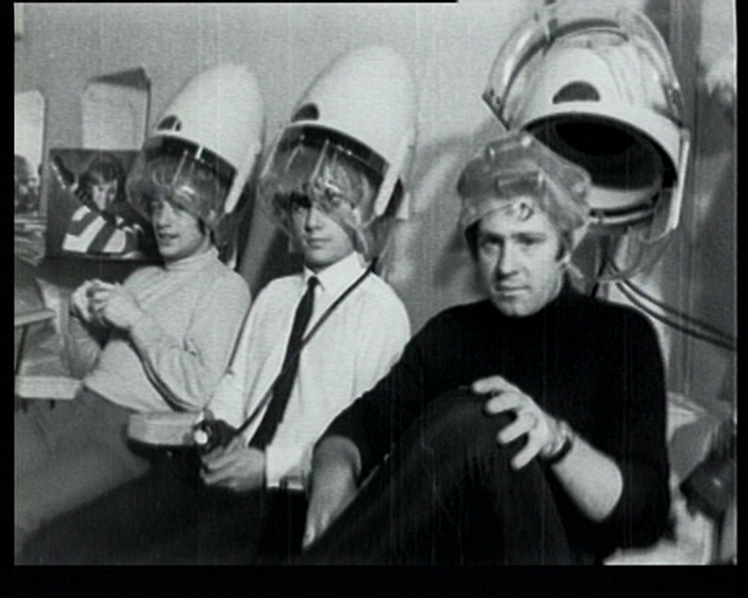
I hope by now you’ve all seen our shagadelic poster for Friday’s Lab, ‘Sex, drugs, and rock ‘n’ roll? Leicester in the 1960s.


The image is taken from the MACE archive, and is part of their collection of ITV regional television news. It was broadcast just over 45 years ago in 1965 and features Birmingham band ‘The Uglys’ beautifying themselves at the hairdresser. They flick though women’s magazines, have their hair washed, get their curlers put in and go for a blast under the hairdryers. The item ends with their curlers unfurled to reveal glossy mop-tops a la Beatles as they saunter out the salon smoking cigarettes -surely the epitome of cool...


The accompanying voiceover would have been broadcast live, so only the images remain in the archival collection. In true ITV style I assume the commentary would have been fairly tongue-in-cheek, something like: “Are you man enough for the mop-top? Brumbeat band The Uglys are not afraid of the girls in the hairdressers” *chortle, chortle*

Susan J Douglas has argued that the relative androgyny of The Beatles is what made them a hit with the ladies - less masculine, less threatening. But what made the style appealing for this local Midlands band -did they think they were embracing their feminine side? Or just achieving a look? Was it all for the cameras? Did the ‘real men’ of the Midlands watching at home scoff at the sight of men in curlers, or reckon they were on to something?

I think this wee news item is interesting, because it represents a nod towards gender negotiations at play in the 1960s. The regional television news was fairly in tune with its audience, it didn’t generally broadcast items that it thought would alienate those watching -it needed them to tune in every tea time. It shows that not only femininity, but masculinity was up for discussion at the time.


And, what happened next…well tune into New History Lab this Friday afternoon and you may well find out!

Monday, 1 November 2010

Raving About History

Are historians only as old as the people they study? If so, that would make me a spritely young scout of the 1920s, twiddling my woggle in a working-class district of Salford, or a daring female flapper, taking in the ‘talkies’ in a showy yellow raincoat. With my own research, and the upcoming New History Lab of Sex, Drugs, and Rock ‘N’ Roll, it seems that youth cultures are everywhere I go. What will the present generation of youth look back on in their dotage? Will our children chortle on their space-bikes as we reminisce about the Ipod, or the ascendancy of the internet? Whatever the next trend may be, it will be surprising if it doesn’t involve some frowned-upon marriage of technology and music with the experimental exuberance of the young. Looking back over the twentieth-century these links make a constant appearance: cinema and jazz in the interwar years, the electrification of rock music soon after, or the explosion of the synthesizer and video games in the 1980s.

Such new forms of entertainment almost always caused some degree of outrage, as the righteous morality of civically conditioned youth experiences like school, boy scouts, girl guides, youth and church clubs were compared unfavourably to the independent, rebellious, and frightening world of experimental music, different forms of dancing, and audacious new fashion. Throw in a handful of drugs, or at least the idea that everyone is indulging in drugs, and you have yourself a moral panic. Where is the crisis of youth in the early-twenty-first century? Sporadically mentioned in the media, perhaps it is the world of ‘stoners’ and their video games: ‘Super Mario made me do it, Miss’. Or the inner-city ASBO youth, who isn’t ‘bovvered’. Or maybe, if you believe the statistics, kids are just too fat to rebel anymore?

Of course, some older forms of youth culture still exist, perhaps championed by elder practitioners, but relegated to the fringes of society- or even the fringes of the urban. Take, for example, the raves of the 1980s, with their acid house music, and ecstasy-fuelled all-nighters. Have a summers-night trundle up into Goyt Valley, a scenic part of the Peak District between the small towns of Macclesfield and Buxton, and you might just chance upon a group of hardcore ravers, usually crowded around a sound-system on the mystical ruins of Errwood Hall. The music might be slightly different, as are the clothes and substance of choice, but it could perhaps still be the 1980s: people sharing in a frowned-upon experience, brought together by music and age. Surprisingly, this annual rave is linked to the tradition of the Buxton Wells Dressing - a more fuddy-duddy form of popular culture, with its traditional queens, local floats and flower displays. Yet, without fail, some of those taking in the sight of friends and family in the daytime carnival will then also make the journey up to the hills for something a little bit less ‘family-friendly’.

I suppose what I’m trying to grasp is the idea that movements from eighty years ago share characteristics with the youth cultures of today, no matter how new and exciting they may seem. In the same way that every generation thinks it invented sex, every generation has a tendency to see itself as pioneers in ‘new’ youth culture. But perhaps we are just extensions of our parents own forays into the cultures of their respective parents? Like anybody with a tendency to wistfully look back at that short period of blossoming early adulthood, I am starting to ramble. So after a cup of tea, a go on World of Warcraft, and a bit of ‘nu-rave’ while reflecting on how the present lot of teenagers has got it ALL wrong, I’m going to go looking for drugs, dirty dancing... and perhaps some pounding techno music.

Errwood Hall, or what’s left of it: http://www.photo-zen.com/photos/big/peak1606.jpg
A rave in Goyt Valley (may contain flashing images!): http://www.youtube.com/watch?v=YXQr0LzpB8Y

Sunday, 31 October 2010

Historia

I have recently returned from holidaying in the Riviera Maya area of Mexico and whilst enjoying both sun and sand I had a few moments and to think about history and just how much I don’t know.

Whilst visiting the Riviera Maya area of Mexico, I visited Chichen Itza and Tulum. To be honest, before I travelled there, I had no idea what Chichen Itza was… did you know it’s one of the new Seven Wonders of the World? Of course, both Chichen Itza and Tulum were beautiful and impressive places to visit (details of which I can share on my return to Leicester). But it was particularly interesting to hear the tour guide explain about the Mayan calendar (stating that it is even more accurate than the one we currently use) and that the iconic temple at Chichen Itza reflects the Mayan calendar - 365 steps to the top platform (one for each day of the year) and during the equinoxes, the setting sun casts a shadow of a serpent on the northern steps of the pyramid.

Whilst hearing him speak it occurred to me that I know next to nothing about Mayan, Spanish or Mexican history, or even in fact, much about any of the South American continent - with the slight exception of some history of the Falkland Islands/Islas Malvinas. These have been British since 1833, and the Argentine Junta presided over economic problems in Argentina in the early 1980s - argued by some to be one of the principal causes of the Falklands War in 1982. Of course the withdrawal from the area of the HMS Endurance due to the Thatcher governments cost cutting measures no doubt encouraged the Junta in thinking the British would not fight to regain the Islands. For political balance previous governments (both Labour and Conservative) had also given indications that British interest in the Falklands were waning. But, my point is, if someone asked me about the history of anywhere else in South or Central America, I would not have a clue.

Of course, as historians, we all have our own specializations that we know and love. I am as guilty as anybody else with that. But we should also make a conscious effort to explore other histories of different places and different times than we normally do. Not necessarily to become experts, as there is far too much history in the world for that, but we shouldn’t lose our enthusiasm for discovery. I believe that is what makes us historians—our passion for history.

This trip made me realise that there is so much history out there and that I should have a greater appreciation of world history. As a start, I’ve just read an article briefly outlining some of the Mayan civilization. Now I know a little more about Mexico than just the beach.