I've been wanting to go for ages but others have been going in front of me and even though I've been bursting I felt I was in a queue and had to wait. Now I've gone I'm really sorry Miriam and Jenny and Gill and Ben about it because now I'm top of the scroll and in fact you guys deserve it more.
Your piece, MIRIAM, on The President's House is a marvellous reminder of the way Americans still believe in their presidents and in their history in general and constantly seek ways of linking it up with their identity. And as you've shown, it's not just the Tea Party People who do such things but the Coalition Against Our Ancestors too. What great names! Can you imagine such a strong embrace and engagement with the national past in this country? Jill Lepore has just published The Whites of Their Eyes (Princton UP 2011) - a very snobby book about how the Tea Party People get America's history all wrong compared to how she, Dr Lepore, Of Harvard and Princeton no less, gets it all right. She says history should have nothing to do with identity. I wonder if the Right On Dr Lepore would say that to the Coalition Against Our Ancestors?
Your piece, BEN, could have metioned Britsih history but didnt. That's where we are these days after years of Tony and Gordon and Dave. Who are all PR and marketing guys at heart. They're against The Past, their own, your's, and everybody else's. That's what New Labour means, after all. The past is so old fashioned. It stops you having absolute power. But I hugely enjoyed the essay and it's northern honesty. Brains and honesty; that's what our politicians need.
Other stuff includes how well LEICESTER HISTORY IDOL went (never thought it would) and how, like The Red Arrows, thay all joined up in the end. Maureen's 17c Anglican ritual and regalia of authority and meaning met Miriam's Star Trek ritual and regalia of authority and meaning somewhere on the other side of outer Warwickshire, and her small face to face communities of early modernity met Ann's small face to face communities of post 1945 New Parks. Wow.
Who won by the way?
Then there was yesterday's gig with GILL and the MUSEUM STUDIES FIVE. Object lesson in how to open up history to the masses. Dont know about Julia Kristeva and, like MALCOLM, I wondered where the Walker's Crisp packet went, but I think we should have a LAB next year based on planning an ALTERNATIVE MUSEUM FOR LEICESTER, put it on site, and then send it to the powers that be with a little gentle mockery that doesn't rule out getting a job with said powers.
Finally, I want to warn LABS and LABBETTES that Paul Lay at History Today is still open for a piece from us in his brilliant journal and if you want to see how that journal goes - I've got a piece in this month called JIMMY'S BLOB. It's probably not what you think, and if it is you're wrong.
Saturday, 19 February 2011

Sunday, 13 February 2011
Controversy Across the Pond: The Reception of The President’s House Site in Philadelphia
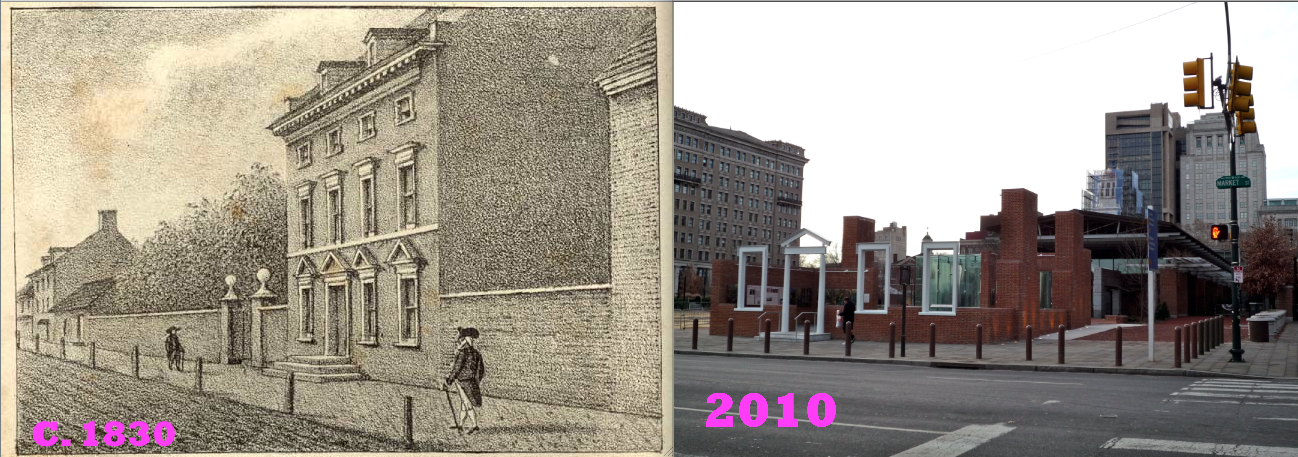
While I was at home over the holidays, I had a chance to stop by the newly opened, and highly controversial, President’s House in Independence Mall. Actually, while this new site is referred to colloquially around Philadelphia (and within the larger Heritage community) as the President’s House, it’s formal title is: The President’s House: Freedom and Slavery in the Making of a New Nation. The controversy stems from both the subject, as well as the design.
The President’s House (PH:FSMNN?), is an eight year, $10.5 million project, undertaken by the City of Philadelphia, with considerable input from the Avenging the Ancestors Coalition. It is positioned within the larger Independence Mall, or Independence National Historical Park, which includes Independence Hall and the Liberty Bell.
It is exactly this placement that sparked controversy and prompted the project. During the construction of the new Liberty Bell Center, the footprint of an earlier building was discovered, which was later discovered to be an outbuilding, perhaps the slave quarters, associated with the President’s House. Following the publication of Historian Edward Lawler’s 2002 article “The President’s House in Philadelphia: The Rediscovery of a Lost Landmark” in the Pennsylvania Magazine of History and Biography a campaign was led by the Avenging the Ancestors Coalition to have a commemorative site built to honor the slaves that were owned my the Nation’s first President.
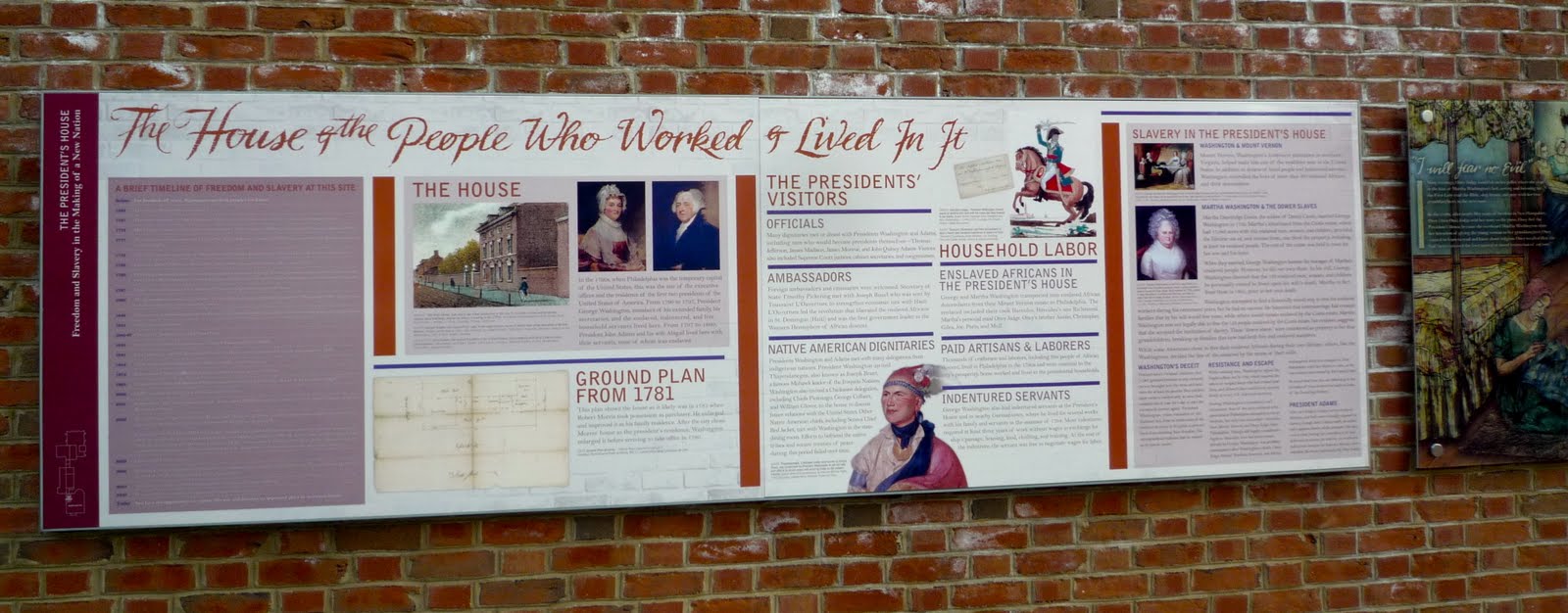
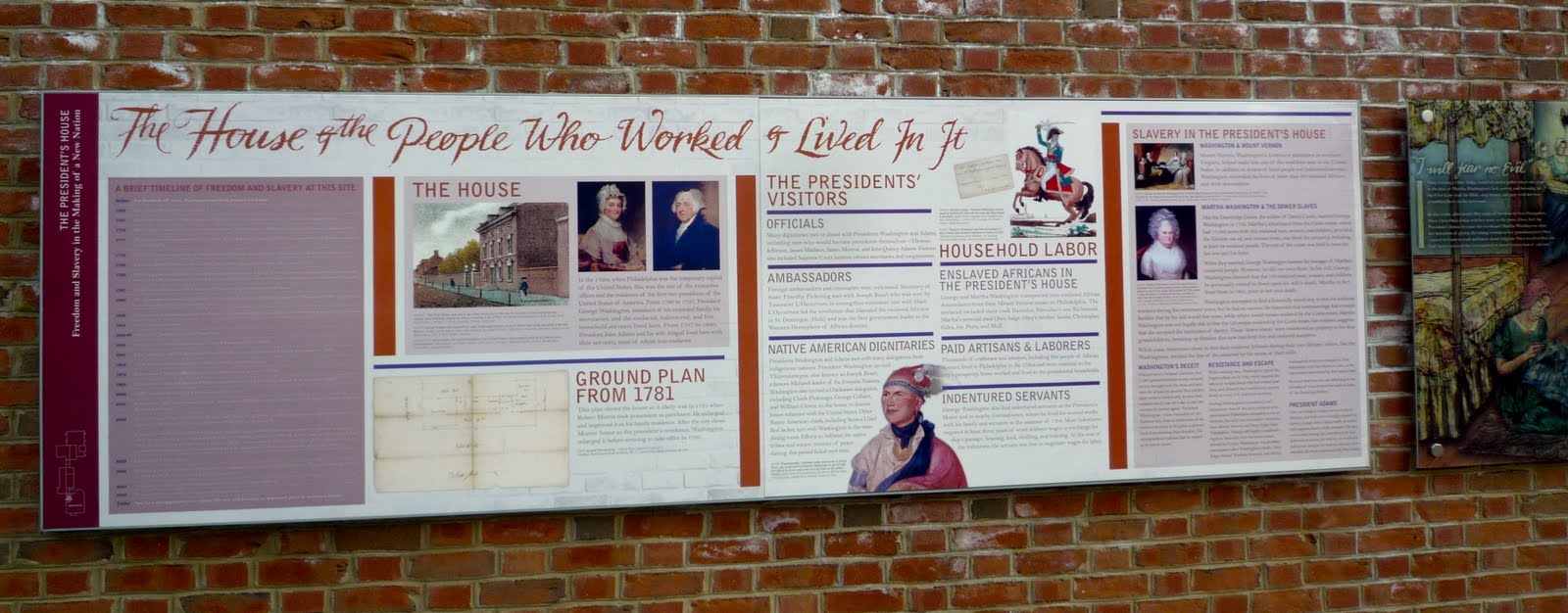
There are major issues with even calling the house “The President’s House”. The house was built in 1767 for another owner and wasn’t even inhabited by Washington until 1790. By then, quite a few people, including Benedict Arnold and Robert Morris, had lived in the house. This is dealt with a bit in the “History of the House and the People who Worked and Lived in it” section, but each of the other inhabitants get about a sentence each.
Officially, this is the first slavery memorial on federal land (to clarify, the African American Museum in Philadelphia, which is one block west of the President’s House, is not a Federal site) so this is a VERY big deal - it’s the 21st century, why has it taken this long? However, if the aim of the site was to discuss slavery in the eighteenth century or even to illustrate the hypocrisy of the founding father’s stance on freedom, then I would have liked to see innovative interpretation. And the exhibit designers seem to have confused innovative interpretation with shiny new technology.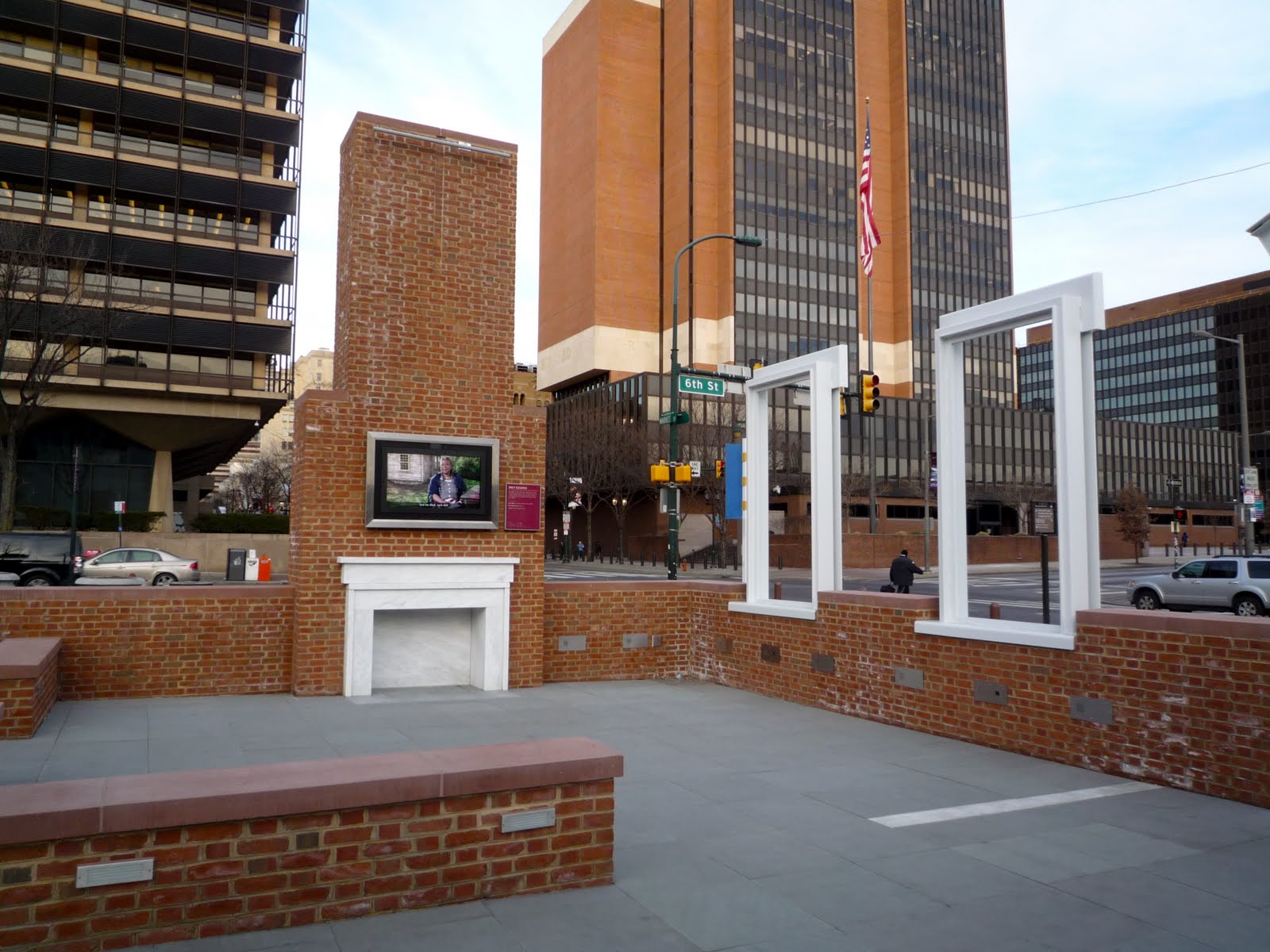
There are five television screens with actors portraying the slaves owned by Washington placed around the site. However, they are all within about seven or eight feet of each other, are running simultaneously and it’s an open-air site on one of Philadelphia’s busiest streets - how are visitors expected to hear what the actors are saying? I was there at about 8:30am, two days before Christmas, so there was decreased road noise, and I had difficulty hearing.
Even with the traditional text panels there are issues. The slave trade and slave-based economy in early America text panels are illustrated with a map that I swear is in every grade school history textbook. 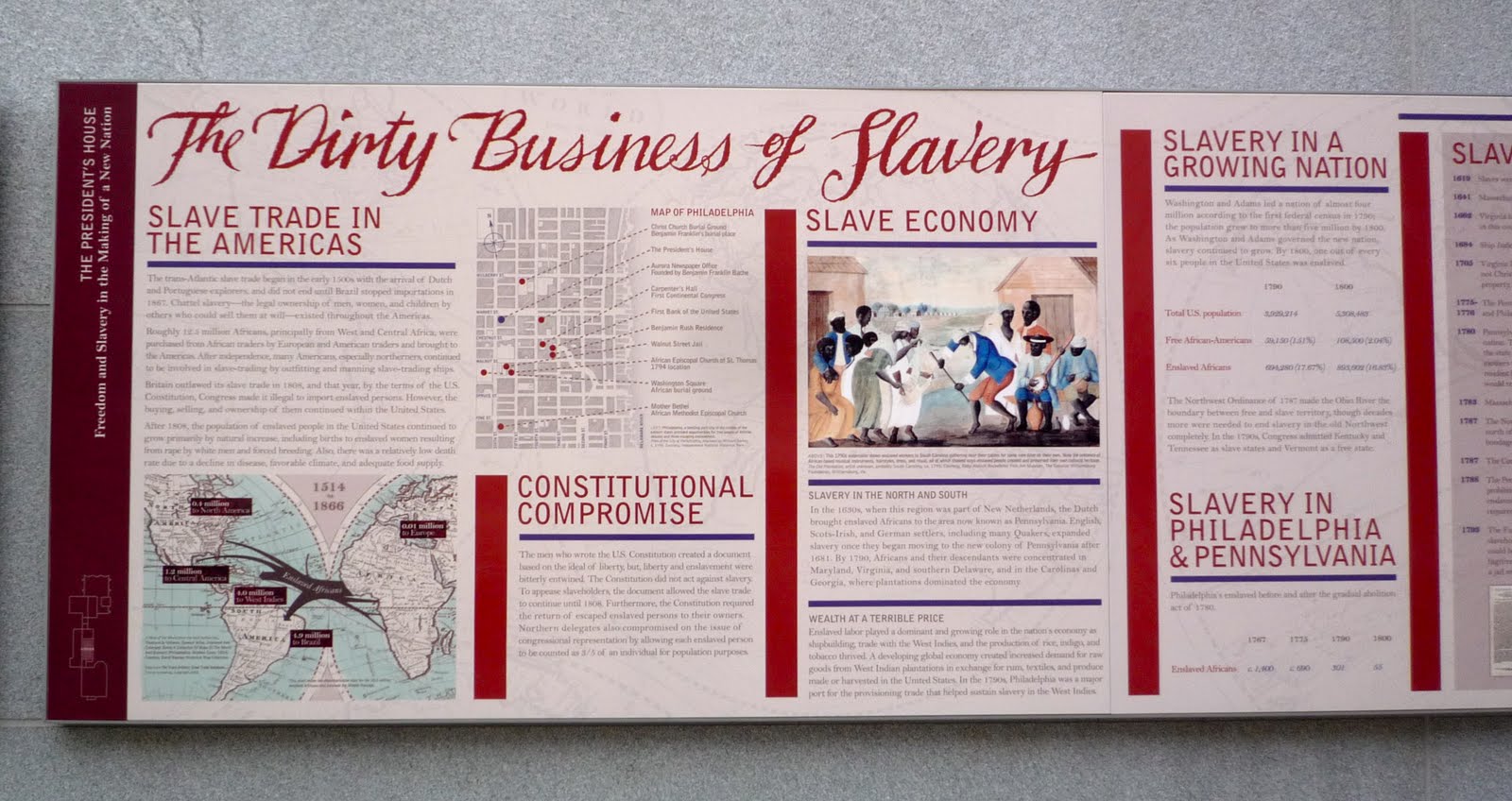 To make this more interesting, more personal, more real, I would have liked to see pictures or maps that illustrated the lives of the slaves that lived at the house - since they have the records of each of these slaves, I’d like to see more on each of them; fewer generalities, more specifics.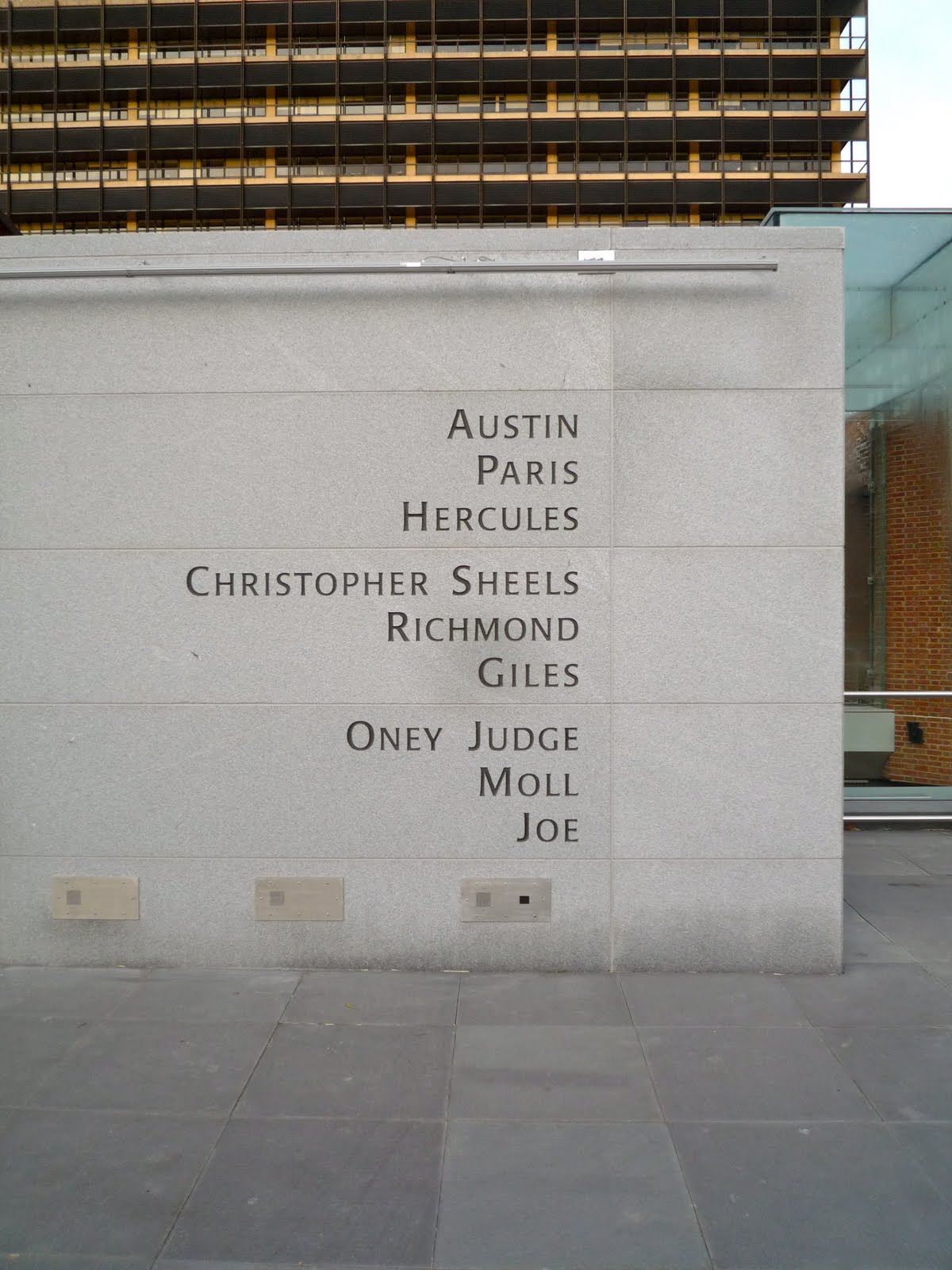
The debate over how to interpret slaves and slavery within this context brings to mind the National Trust and their interpretation of “downstairs” history in their country house properties and its associated negative reviews. Some have felt that the NT has put a considerable amount of effort exploring the world of the servants in many of their properties only to be incredibly patronizing in their efforts. On the flip side, others have felt that by putting the servants first, the reason for the servants has been lost - that is, the attention has been too far removed from the family that owned the property.
Both of these debates make me wonder about how the decisions are made as to what aspects of sites/history should be interpreted. In a perfect world, the entire history would be interpreted in some way, but clearly it would be hard to cover vast amounts of history well.
Okay, rant over.
If you’re interested, you can read more about the debate here:
Mr. Cameron and Our Identity
As my first blog this post caused me numerous headaches. Day-to-day I muse over many things, but when I came to write them down I realised how obscure many of them were. I settled on this and then set about it like a spoilt child, attempting to engage a topic that would take at least a hundred blogs. So here I will leave you with my general musings, and probably more questions than answers, but I promise you it is due to no lack of thought.
Cameron’s speech a week last Friday was a political point scorer, designed to capitalise on the general shift to the right common across Europe. Embracing Britishness would not deter extremists. I do not know any personally but I cannot imagine they would be swayed by more fish and chip suppers. The speech was the kind of empty talk common from the Prime Minister. For instance it clashes hopelessly with the flagship free schools policy; an invitation to develop and teach a separate identity.
Another clash is the adherence to market forces of this ‘child of Thatcher’ (a tag he has defended). The free market brought the large swathes of immigrants that now frustrate Cameron through lack of integration. At a lower level it erodes our heritage. It has rundown industry, seen the replacement of terraced houses (symmetrical as these things look they vary massively between areas) with mock Tudor estates, soulless bowl-shaped football stadiums with commercial names, and the growth of postmodern style shopping centres in seemingly every town. Now obviously these are matters of regional not national identity, but you need this diversity for wider unity. Without it you would have a nation of uncomfortable clones.
So maybe the Big Society and localism is the answer? The thing with identity is that it must be spontaneous, one of the few generalisations you can make on the topic. This confusion has lead to Cameron’s horrible phrase, ‘muscular liberalism’, liberalism enforced, which is not liberalism at all. He talks of reigning in ‘rootless’ Brits. He never suggests evolving our identity to encompass all (no political points there). I do not see why an identity need be fixed. For me the way the British people like to see themselves is rooted in the Second World War and the underdog spirit, though it also draws on earlier history. There must have been some identity prior to this. Consult any contemporary commentator on the issue, and they will almost certainly tell you their identity is in crisis, or at least in transition. I am not saying any transition would be painless, but it might be possible, and perhaps it is already underway.
The point I mused over most, is do we need an identity? I was tempted to write a blog arguing no, and in concrete terms I struggle to see a drawback, but I could not do it. Imagine if someone threatened to remove yours, it is an uncomfortable feeling. God knows I could never feel Southern. What would be the implications if I had to? I once raised this point with a friend, who said, ‘to love another you must first love yourself’. A lack of feeling for your identity and history is liable to make you ruthless and less humanitarian. Just look at the Chinese state, chavs and management students.
Perhaps I am over thinking things. During a major international tournament, observe how many football fans will tell you the country is pulling together and feels united. This is without thought for extremists, what the bankers did, or the fact that even in England’s biggest games, less than half the population watch the match. Perhaps therefore creating cohesive feeling is as easy as Dave hopes, and I am over-romanticising, for as much as I deplore the reduction of regional identity I have no desire to live in an industrial terrace and work in a coal mine, but clearly he is endorsing some clashes of interest. It would be unfair to say he did not think his speech through, as he was not talking to me, the pedantic lefty, but it would be refreshing to hear less empty talk.
Cameron’s speech a week last Friday was a political point scorer, designed to capitalise on the general shift to the right common across Europe. Embracing Britishness would not deter extremists. I do not know any personally but I cannot imagine they would be swayed by more fish and chip suppers. The speech was the kind of empty talk common from the Prime Minister. For instance it clashes hopelessly with the flagship free schools policy; an invitation to develop and teach a separate identity.
Another clash is the adherence to market forces of this ‘child of Thatcher’ (a tag he has defended). The free market brought the large swathes of immigrants that now frustrate Cameron through lack of integration. At a lower level it erodes our heritage. It has rundown industry, seen the replacement of terraced houses (symmetrical as these things look they vary massively between areas) with mock Tudor estates, soulless bowl-shaped football stadiums with commercial names, and the growth of postmodern style shopping centres in seemingly every town. Now obviously these are matters of regional not national identity, but you need this diversity for wider unity. Without it you would have a nation of uncomfortable clones.
So maybe the Big Society and localism is the answer? The thing with identity is that it must be spontaneous, one of the few generalisations you can make on the topic. This confusion has lead to Cameron’s horrible phrase, ‘muscular liberalism’, liberalism enforced, which is not liberalism at all. He talks of reigning in ‘rootless’ Brits. He never suggests evolving our identity to encompass all (no political points there). I do not see why an identity need be fixed. For me the way the British people like to see themselves is rooted in the Second World War and the underdog spirit, though it also draws on earlier history. There must have been some identity prior to this. Consult any contemporary commentator on the issue, and they will almost certainly tell you their identity is in crisis, or at least in transition. I am not saying any transition would be painless, but it might be possible, and perhaps it is already underway.
The point I mused over most, is do we need an identity? I was tempted to write a blog arguing no, and in concrete terms I struggle to see a drawback, but I could not do it. Imagine if someone threatened to remove yours, it is an uncomfortable feeling. God knows I could never feel Southern. What would be the implications if I had to? I once raised this point with a friend, who said, ‘to love another you must first love yourself’. A lack of feeling for your identity and history is liable to make you ruthless and less humanitarian. Just look at the Chinese state, chavs and management students.
Perhaps I am over thinking things. During a major international tournament, observe how many football fans will tell you the country is pulling together and feels united. This is without thought for extremists, what the bankers did, or the fact that even in England’s biggest games, less than half the population watch the match. Perhaps therefore creating cohesive feeling is as easy as Dave hopes, and I am over-romanticising, for as much as I deplore the reduction of regional identity I have no desire to live in an industrial terrace and work in a coal mine, but clearly he is endorsing some clashes of interest. It would be unfair to say he did not think his speech through, as he was not talking to me, the pedantic lefty, but it would be refreshing to hear less empty talk.
Subscribe to:
Posts (Atom)

 Posts
Posts