Sorry that should read origin of the University...as explained at yesterday's well attended Lab in Siobhan Begley's beautifully elegant, and eloquent, lecture.
The University of Leicester, founded in 1921, had its origins in the coming together of four great associations - the Literary and Philosophical Society, founded in the 1830s to reunite the town's middle classes after years of sectarian strife; the Leicester Ladies' Reading Society, founded in 1869 because women members were not allowed in the Lit & Phil; Rev David Vaughan's Working Men's College, founded in 1862 on Christian Socialist principles (and still a key part of the University as the Institute for Lifelong Learning); and The National Council of Women, founded in 1897 to coordinate charitable projects in the town.
So, two men's associations and two women's associations created your University - nothing to do with AHRC or ESRC or HEFCE or any of that bureaucratic crew, and everything to do with what was local, practical, and visionary. Thankyou Siobhan.
As well, Tim Davies returned to his old stamping ground to explain his work on (what he managed to say between mouthfuls of cake as) 'Self help Self health'. Very soon we were right up against the internal organs of the Victorian bourgeoisie and the pills potions and powders and balms that were sold to stop them hurting so much - or should that be 'splurting' so much?
So, as the sun set over the Lab and we scaled the heights of Leicester's ambition to build a new Universe in its midst (a la Begley), so we remembered the swollen gums, inflated stomachs and crushed kidneys of those who made it so. Thankyou Tim for such a timely reminder of the material basis of History. And over to you Tristram...
Saturday, 28 February 2009

Friday, 27 February 2009
Manchester, Engels and the Making of Marxism
I know you are all excited about our forthcoming Lecture. There will be the usual cake + history + pub, but the event also brings this year's New History Lab sessions to a close. Don't be too despondent: below you can read the blurb from Tristram, which is bound to cheer you up. Remember we start an hour earlier (cake 3:30pm, start by 4pm).
"Friedrich Engels, co-author of The Communist Manifesto and life long ideological ally of Karl Marx, lived in Manchester from 1842-44 and 1850-1870. Each period of residency proved instrumental in the development of Marxism. The first gave Engels an understanding of materialism, the proletariat and the function of private property - all of which came to be expressed in The Condition of the Working Class in England (1845). His longer stay in 'Cottonopolis' - as a merchant in the cotton industry - not only brought to light the troubling contradictions of Engels's bourgeois existence, but through Manchester's public culture of science helped turn his thinking in a markedly scientistic direction. This proved the essential and under-appreciated intellectual preamble for Engels's far more scientific interpretation of Marxism in the 1870s and 1880s (Anti-Dühring; Dialectics of Nature) and much of what constituted official, 20th century Marxism.
Dr. Tristram Hunt, historian of the Victorian city and biographer of Friedrich Engels at Queen Mary, University of London, will explore the changing role of Manchester in the development of Marxism on Friday 13th March…"
New Cake Lab: part 2
Banana Bread.
The lovely Sandra was keen to have the recipe to this. Based on one by Michael Barry from the BBC website a long time ago.
Primary source materials
8oz self-raising flour
4oz marg
4oz sugar
1lb bananas (weigh with skins on, then peel and mash)
2 eggs
6oz sultanas
Methodology
1. Heat oven to 180°C.
2. Mix all the ingredients except the sultanas together.
3. Mix thoroughly and add sultanas. Transfer to loaf tin, and bake for around 90mins. It's ready when a knife comes out clean.
In 60 minutes the heavy tinted doors...
...of the New History Lab will swing open and the white coated ones will be at it again beating back the bounds of knowledge from the flame of learning in the temple of doom. Bunsens will be lit in readiness to the test tubes will be held up to the light just to show Professor King that we know what we know we know even though we're not scientists. Today, Siobhan Begley and Tim Davies will report on their PhD researches. Tim does drugs. Siobhan does gangs. So there should be lots to talk about - especially if specimens are offered.
So see you soon, Friday 27 February, usual place (1 Salisbury Rd), usual stuff (430 for tea and cake followed by trip to pub), and just a little bit of lab work squeezed between the lemon sponge. That'll do nicely.
So see you soon, Friday 27 February, usual place (1 Salisbury Rd), usual stuff (430 for tea and cake followed by trip to pub), and just a little bit of lab work squeezed between the lemon sponge. That'll do nicely.
Methodism in the northern coalfield.
Obviously your first duty is to the lab, but if you are at a loose end next Friday (6/3), then pop along to the CUH seminar at 2:30pm to hear our very own Rob Colls tell you all about Methodism in the northern coalfield. For those who went on our first peregrination to Stoke to see pottery museums and the birth place of primitive Methodism, this is bound to be of interest.
Thursday, 26 February 2009
Free Online Books Every Student of Humanity Should Read
An American blog has compiled a list of 100 free online books that "every humanities student should read". You may not agree with the choices but it's a useful list of links in one place.
Wednesday, 25 February 2009
Old cake lab
Here's an old one that I might try one day:
Uxbridge Cakes
Uxbridge Cakes
Take a pound of fine flour, seven pounds of currants, half a nutmeg, and four pounds of butter, mix your currants well in the flour, butter, and seasoning, and knead it with so much good new yeast as will make it into a pretty high paste; after it is kneaded well together let it stand an hour to rise, and put about half a pound of paste into a cake.(From: Richard Briggs, The English art of cookery (London, 1794), p. 455.)
Discoveries
The next lab is this Friday. Rather than giving you the usual epithet or quotation, I'm just going to say that regular labber Siobhan Begley and former student Tim Davies will be giving their papers, both of which are about things they discovered about Leicester during their PhDs: one on the founding of the University, the other on marketing drugs in the city. I think the speakers and their subject matter will be enough to sell it to you.
As usual, tea and cake from 4:30pm!
See you then,
Malcolm
As usual, tea and cake from 4:30pm!
See you then,
Malcolm
Thursday, 19 February 2009
Singing the praises of digitized ballads.
Previous stories on this blog have considered a number of digitization projects. The English Broadside Ballad Archive at the University of California-Santa Barbara has to rate amongst the very best which I have seen. The most innovative feature is the 'Facsimile Transcriptions' option, whereby transcribed roman text is superimposed over the original black letter, rendering the whole thing highly readable, but preserving the original layout and contextual illustrations. No wonder it won the British Society for Eighteenth Century Studies Digital Eighteenth Century Prize for 2009. Whilst it may be a bit of a mouthful, it is certainly earned. Do visit it, so you can see the most famous diarist's ballad collection.
Wednesday, 18 February 2009
Your name on a bus!
Urban historical web master Stephanie sent me this rather funky text web page. Ever wanted to see your name on a bus? Now is your chance! Not all that historical, but rather good fun all the same.
Tuesday, 17 February 2009
New Cake Lab: part one of many: NHL Saucepan Cake!
Who needs Nigella when we have our very own Ann? Her delicious New History Lab Saucepan Cake has been a great hit. I reckon the brazil nuts are the master stroke as walnuts can be rather bitter. This is the first in what I hope will be a rather long and delicious series, with further instalments including one from that other domestic goddess, Rob, and his delicious lemon cake. Thanks, Ann!
Ingredients
12 oz well crushed digestive biscuits
3 oz butter
3 tbs golden syrup
7 oz chocolate
1 orange
1.5 oz glace cherries
1.5 oz finely chopped nuts (I use brazils)
1.5 oz sultanas
Method
Melt chocolate, butter and golden syrup in a saucepan.
Add juice of half an orange.
Stir in all the rest.
Divide mixture between two Victoria sandwich tins lined with non stick paper.
Flatten down with the other half of the orange.
Chill for 1 hour.
Divide each into twelve sections (but keep in tin)
Chill until fully set.
Enjoy!!!
Monday, 16 February 2009
Sex education films in the British Film Institute
The BBC website has an interesting article about the style and role of sex education films, including a video of 'WHATSOEVER A MAN SOWETH' (1917) which it describes as 'a bit more Shakespeare than sex education'. This article suggests a fascinating area of research for those with an interest in the role of visual resources for educational purposes, or indeed perceptions of sex.
More info at http://news.bbc.co.uk/1/hi/magazine/7892257.stm
More info at http://news.bbc.co.uk/1/hi/magazine/7892257.stm
Sunday, 15 February 2009
'H seeks A. B, no other Rex'
Love letters and Henry VIII, are two words which one would be forgiven for not automatically linking together. However, a recently dicovered letter from Henry VIII to Anne Boleyn about to be exhibited in the British Library may make you think twice. Phrases such as 'my heart will be dedicated to you alone' and signed 'H seeks A. B, no other Rex' shines another light on the the history textbook tale which ends in the swift execution of Anne.
See http://news.bbc.co.uk/1/hi/uk/7887826.stm for more details.
See http://news.bbc.co.uk/1/hi/uk/7887826.stm for more details.
Saturday, 14 February 2009
Tristram Hunt on BBC 4
New History Lab speaker Tristram Hunt is presenting an episode of the series 'The Joy of Motoring' next week on BBC 4. It's on at 9:00pm on Wednesday (19th Feb).
Friday, 13 February 2009
Eighteenth-Century Vampirism
A few years ago I found this nice bit of foreign journalism in the Gentleman's Magazine. I think it's worth sharing:
From Madreyga in Hungary, That certain dead Bodies called Vampyres, had kill’d several Persons by sucking out all their Blood. The Commander in Chief, and Magistrates of the Place were severally examin’d and unanimously declared, that about 5 Years ago, a certain Heyduke named Arnold Paul, in his Life Time was heard to say, he had been tormented by a Vampyre, and that for a Remedy he had eaten some of the Earth of the Vampyre’s Graves, and rubbed himself with their Blood. That 20 or 30 Days after the Death of the said Arnold Paul, several Persons complained they were tormented; and that he had taken away the Lives of 4 Persons. To put a Stop to such a Calamity, the Inhabitants having consulted their Hardnagi took up his Body, 40 Days after he had been dead, and found it fresh and free from Corruption; that he bled at the Nose, Mouth and Ears, pure and florid Blood; that his Shroud and Winding Sheet were all over Bloody; and that his Finger and Toe Nails were fallen off, and new ones grown in their room. By these Circumstances they were perswaded he was a Vampyre, and, according to Custom, drove a Stake thro’ his Heart; at which he gave a horrid Groan. They burnt his Body to Ashes, and threw them into his Grave. ‘Twas added, that those who have been tormented or killed by the Vampyres become Vampyres when they are dead. Upon which Account they served several other dead Bodies as they had done Arnold Paul’s, for tormenting the Living.The item appeared in 1732, and predates the earliest citation of the word 'vampire' in the OED. It must therefore be one of the earliest accounts of vampirism in English. John Polidori refers to it (or, at least, another version published elsewhere) in the introduction to his brilliant 1819 short-story 'The Vampyre'.
Tuesday, 10 February 2009
Cool Text Tools, part 2
Next is the much more nerdy Text Stat. This is a free and relatively simple computer program which can analyse text corpora. One of its most useful functions is its ability to produce a frequency list of all the words in a text. For example, I used it to find that there are 39 references to 'king' or 'kings' in John Dryden's Absalom and Achitophel - 'parliament' and its variants do not appear. This is interesting, because I expected that word to appear at least somewhere in a thousand-line poem about the king's relationship with parliament.
Of course, one shouldn't read too much into what is little more than a crude count of how many times a word appears in a document. However, being able to look at texts from an entirely new angle might prove to be a useful stimulus of new ideas. One could then investigate them by doing a proper, conventional reading of the texts.
Of course, one shouldn't read too much into what is little more than a crude count of how many times a word appears in a document. However, being able to look at texts from an entirely new angle might prove to be a useful stimulus of new ideas. One could then investigate them by doing a proper, conventional reading of the texts.
Monday, 9 February 2009
Legacies and Futures: The History Workshop and radical education (CFP)
Cynthia (who gave the paper on the land grabbers) has sent me details of this call for papers, for a conference to be held on 19/9/2009 at Ruskin College, Oxford. - looks good fun!
The recent opening up of the History Workshop archive at Ruskin College - in addition to the Raphael Samuel Archive at the Bishopsgate Institute - provides new opportunities for thinking about History.
The History Workshops held in the 1960s, 70s and 80s provided particular opportunities for wide-ranging discussions of History and its application in the present. The History Workshop Movement was seen as a radical movement dedicated to political change and new ways of thinking about the past and present.
While discussion of the past in the public domain has arguably opened up extensively, History in schools, colleges, universities and adult education is circumscribed by different constraints to those of the early years of the History Workshop.
What are the possibilities now of practising radical history-making? Is democratic scholarship viable - and what forms can it take? What new forms of engagement are possible? What have we learned and what should be left in the past? What different roles might History have in local and community activism?
This one day conference is not intended to be a nostalgic event but to provide an opportunity to think about and discuss visions and practical examples now. We are also exploring publication of conference contributions.
Speakers include Dr Anna Davin, editor of History Workshop Journal, Ken Jones, Professor of Education at Keele University and author of Schooling in Western Europe: the new order and its adversaries (Palgrave 2008),Jorma Kalela, Professor (emeritus) University of Turku and author of The Historian in Society (forthcoming 09/10) Marjorie Mayo, Professor of Community Development & Head of the Centre for Lifelong Learning and Community Engagement Goldsmiths College, University of London and author of Global Citizens (Zed 2006)
Please send proposals for both analytical and practical papers, presentations, displays in no more than 200 words by 31 March to Kynan Gentry [email protected] and Hilda Kean [email protected]
Poster this: Festival of Postgraduate Research (CFP)
Here are some details of the poster festival of postgraduate research held in July. A worthwhile activity - it would be great to see more history being put out there!
For the fifth successive year, the University of Leicester is holding its one-day poster presentation exhibition to showcase postgraduate research to employers and the general public, as well as to the wider research community. As a postgraduate researcher, this is an exciting opportunity to publicise your research to new audiences and to make useful contacts. There will also be the opportunity to win substantial prizes provided by employers for the best presentations. In addition, the best exhibitors will be asked to represent the University of Leicester at a regional competition organised by Vitae on Tuesday 7th July 2009.
Posters should be designed to explain your research to the widest possible audience. The University will select the 50 best proposals from postgraduates across the University. These proposals will be posted on the Festival of Postgraduate Research website and promoted to academics, employers and the press. The selected postgraduates will then have the opportunity to attend a one-day training course entitled Presenting Research to Different Audiences covering poster design, employability, networking skills and media awareness.
Successful applicants will be invited to present their posters on Thursday 25th June in the Belvoir Suite, 2nd Floor, Charles Wilson Building, to an audience drawn from the University, employers and the general public.
For details of the application procedure, and further information, visit the graduate school website.
More detailed information briefings will be held from 1-2pm in the Student Development Zone Seminar Room (David Wilson Library) on:
Monday 9th February, and Thursday 12th February
The deadline Friday 6th March 2009.
Sunday, 8 February 2009
A nation obsessed with weather
"Pray don't talk to me about the weather, Mr. Worthing. Whenever people talk to me about the weather, I always feel quite certain that they mean something else."
What with the recent chilly snap, the topic of snow seems have been almost the sole topic of conversation of late. This rather interesting article on just how jolly cold it got in 1947, and the consequences of such a chill, then, is bound to go down rather well. From The Times.
Friday, 6 February 2009
Lizard poo research project thrown away
Imagine spending years collecting lizard poo for your thesis, only to have it thrown out! This happened to one poor chap at Leeds University. See this THE article Oh crap - there goes my work for more details of this unfortunate incident. At least you can back up paper notes...
Cool Text Tools, part 1
This is the first in a two-part series about tools which can be used to look at text in unusual and interesting ways. First up is Wordle, which produces beautiful typographical representations of any text that you feed into it. Below is my version of John Donne's elegy 'To his mistress going to bed'. It took me about two minutes to produce and I think it's great.
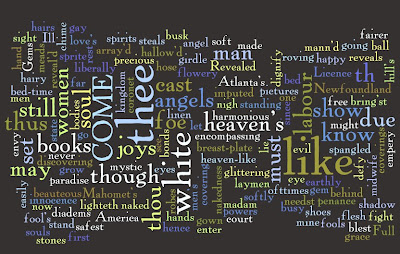
The Wordle image is copyright Wordle.net. Part 2 on Tuesday.
The Wordle image is copyright Wordle.net. Part 2 on Tuesday.
Thursday, 5 February 2009
Knowing me knowing you knowing Leicester
We all thought we knew why we loved Leicester until last Friday Colin Hyde showed us Leicester's buildings as the Victorians knew them, and valued them, and Cynthia Brown introduced us to the 'land grabbers' - men who in 1909 tried to show the Poor Law a better way. Leicester is always coming up with this sort of stuff - out of the way architectural gems down a lane and up a jitty, and stunning examples of working class radicalism throughout the modern period. You just have to know where to look and New History Lab showed us just that. I think a tour of this England's 'most radical city' (Bill Lancaster) is well overdue. Let's do Chris and Gervase's SHEFFIELD ((7 March) and then move onto the Queen's Road massive.
Next up (13 February) is Professor Andrew King from Physics on what it is to know what we know or, what do scientists think they're up to? Knowing what we know is not as easy as social scientists and historians thought it was. Just out in Australia is a little pot boiler The Trouble With Theory, or the Educational Consequences of Post Modernism by Gavin Kitching. Kitching is professor of politics at University of New South Wales. He looks at the top dissertations over recent years in his department and shows how they have been seriously misled and confused by the assumptions of (what he calls) bad philosophy. It has all caused a minor cause celebre in OZ Higher Education and we should get him for next year. Meethinks.
yours sincerely
The Pink 'Un
Next up (13 February) is Professor Andrew King from Physics on what it is to know what we know or, what do scientists think they're up to? Knowing what we know is not as easy as social scientists and historians thought it was. Just out in Australia is a little pot boiler The Trouble With Theory, or the Educational Consequences of Post Modernism by Gavin Kitching. Kitching is professor of politics at University of New South Wales. He looks at the top dissertations over recent years in his department and shows how they have been seriously misled and confused by the assumptions of (what he calls) bad philosophy. It has all caused a minor cause celebre in OZ Higher Education and we should get him for next year. Meethinks.
yours sincerely
The Pink 'Un
Wednesday, 4 February 2009
Cabinet Papers 1915-1978.
The lovely people over the road at museum studies beat us, but the Cabinet Archives 1915-1978 are now online. This is yet another demonstration of the digitization of primary sources, of which a good number have been posted on this blog of late. What this really proves is that there is simply too much twentieth-century material through which to wade; the nineteenth century is the place to be.
Tuesday, 3 February 2009
Leicester: Sound and Vision
Thanks to Colin and Cynthia for two fantastic papers on Friday.
For those who enjoyed Colin's photographs, this webpage has lots of pictures - including Top Hat Terrace on London Road - a personal favourite of mine. Another Hyde-EMOHA website which may be of interest is Semper Eadem (always the same), featuring interiors of shops which haven't changed. Lots of online exploration to keep you busy until the snow goes.
Subscribe to:
Posts (Atom)


 Posts
Posts



