Tuesday, 17 March 2009

End of year: Dr Hunt and Dr Tompkins.

I hope you all enjoyed Friday's lecture. Big thanks to Tristram for coming up and speaking to us.

And so, the first year of the New History Lab is over. Not quite as an encore, but rather as some kind of a coda nonetheless, I present to you Dr Matt Tompkins' inaugural lecture. It all fits rather nicely, as he started off the very first New History Lab in October. It is a real coup for the History department to get one of these, and reflects the quality of Matt's scholarship. Entitled 'Headsilver: taxation, plague and population in a late medieval village', it will tell us some of the findings from thesis. You've already heard about Matt's experiences producing it. You've read the book: now see the film.

I do hope you can all make it. Rumour has it there is a complimentary glass or two of plonk afterwards. A free drink from the University? Yes, really! All the fun starts at 5:30pm on Wednesday in Ken Edwards Lecture Theatre 3. A good chance to wear your wristbands again.

Remember that some mugs are available from Lucy Byrne in the ELH office, for a mere £5. What a bargain!

Finally, may I thank the speakers, bakers and attendees who made this such a fantastic opening season? I have never seen quite as much pink as I did on Friday, and chances are, I may not do again. The whole thing has gone swimmingly, and will return in the autumn: watch this space. But for now, thank you.

Thursday, 12 March 2009

Lecture.

Are you as excited as I am? I hope so! Preparations are fully under way for the last lab of the year (cake and tea, that sort of thing).

If you could look out your pinkest clothes (whatever they might be), then it will be extra cake for you! As you know, pink is the lab's trademark colour and it would be grand if we could all wear something pink. A scarf, tie, jumper, watch, whatever!

Great - see you tomorrow. Remember it is 3.30 (an hour earlier) for cake, for a 4pm start. Be there nice and early to be sure of a seat. All welcome, as usual.

Historical Photos on Flickr


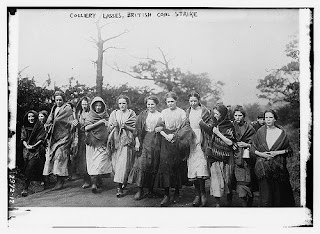
Flickr seems to be being used more and more as a place to upload historical images, especially in America. The Library of Congress is a good source and recently posted some rare photos of Lincoln to celebrate President's Day. Check out the section News in the 1910s for some great photos of America and world in the early 20th century.

(Image from the Bain News Service 1910-1915 - Colliery Lasses, British Coal strike)

Wednesday, 11 March 2009

Triangle Shirtwaist Factory fire

Following our discussion at the book group meeting on The Jungle tonight, here is the industrial accident I was referring to: the Triangle Shirtwaist Factory fire of 1911. Fifty women jumped to their deaths, and the total death toll was 146.

Tuesday, 10 March 2009

eurovision, political, never!

'We don't wanna put in!' say it a few times quickly and contemplate the (even more) hilarious nature of Eurovision which is hosted in Moscow this year!

The above title of the Georgian entry has been told to be re-written or a new song has to be found.

Viva Eurovision for such joys!

http://news.bbc.co.uk/1/hi/entertainment/7935865.stm

The Great Patriotic War?

The Great Patriotic War? A holocaust denial, without the holocaust?

Prosecutor-General Yury Chaika has suggested that the denial of the Soviet victory in WWII may result as a criminal offence.

See this article for a little more detail: http://www.rferl.org/content/State_Of_Denial/1502774.html

Russia as always is a facinating place, what more can I say!

(Thanks to Mark Hurst for forwarding me this article!)

A pink letter day!: the first NHL Lecture.

Our final session of the 2008/09 academic year approaches. You need not be disconsolate, as it is to be given by Dr Tristram Hunt (Queen Mary University), and is derived from his eagerly-awaited biography of Engels, The Frock-coated Communist: The Revolutionary Life of Friedrich Engels (Penguin, forthcoming i.e. April 2009). His abstract has been published here before, but it is worth reprinting it as a reminder.

Manchester, Engels and the Making of Marxism

Dr Hunt: "Friedrich Engels, co-author of The Communist Manifesto and life long ideological ally of Karl Marx, lived in Manchester from 1842-44 and 1850-1870. Each period of residency proved instrumental in the development of Marxism. The first gave Engels an understanding of materialism, the proletariat and the function of private property - all of which came to be expressed in The Condition of the Working Class in England (1845). His longer stay in 'Cottonopolis' - as a merchant in the cotton industry - not only brought to light the troubling contradictions of Engels's bourgeois existence, but through Manchester's public culture of science helped turn his thinking in a markedly scientistic direction. This proved the essential and under-appreciated intellectual preamble for Engels's far more scientific interpretation of Marxism in the 1870s and 1880s (Anti-Dühring; Dialectics of Nature) and much of what constituted official, 20th century Marxism. "

Wear Something Pink for Free Food

In honour of the occasion, please wear something pink. It could be anything - scarves, jumpers, pocket handkerchiefs, socks - you name it! Those wearing an item of pink clothing will be pleased to learn that the pub will be offering the complimentary nibbles to celebrate the occasion.

REMEMBER THAT WE START AT 3:30PM not 4:30PM this week. And I'd get there early to be sure of a seat.

Monday, 9 March 2009

As promised: Sheffield flood claims.

Usually, insurance claims are boring and annoying. If you've had the misfortune to make one, you'll understand. However the historical archive about which Gervase told us on Saturday may change your view of this. Follow the link to find out all about the claims people made to the water company. Because they accepted liability, you can find out about a full cross-section of the population, not just those with policies.

Sunday, 8 March 2009

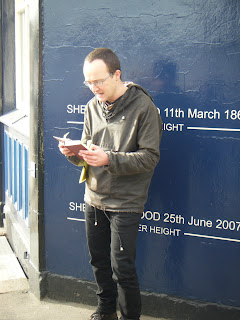
Sheffield: a city of seven hills, five rivers and two fine lead peregrinators.


Rome, infamously, was built on seven hills. So too, we learnt, was Sheffield. Whilst Rome was the pinnacle of the Grand Tour, Sheffield has not been the subject of quite so much antiquarian interest. Indeed, there might not have ever been a peregrination to Sheffield ever before, and chances are nobody will mount one any time soon. So we must have added to the history of this city.
What an unutterable success! Many thanks to our two lead peregrinators. Due to their scholarship and enthusiasm, we saw a very great deal, learnt a lot, and visited a number of fine hostelries. And, of course, thanks for coming! I do hope those who attended enjoyed themselves.
See you on Friday for the end-of-year lecture from Tristram Hunt. More details will follow throughout the week on the blog.

Thursday, 5 March 2009

The Great Sheffield Flood of 1864

MetaFilter has a good collection of links relating to the Great Sheffield Flood.

Mr French assures me that the city is now perfectly safe. In fact, we're going there this Saturday...

Five events that changed Britain forever?

Dan Snow, historian, and reporter for BBC 1's 'The One Show', has recently reported upon 5 events that changed Britain forever. His list contains:
  • The first passenger steam train
  • The day the Windrush arrived
  • The day the Magna Carta was sealed
  • The day the Romans invaded
  • The day the East India Company got its charter
I would be fascinated to hear what people think about these choices, I'm still pondering my response currently.

To see video clips of Dan Snow reporting on this go here

History of medicine brought to life.

A660037, Science Museum, London.

A splendid new Science Museum website features a wealth of information on the history of medicine, alongside a range of pictures and photography ranging from the aesethically-pleasing (I liked the tray of artificial eyes) to the utterly gruesome. The images are bound to be a useful scholarly resource, but the site as a whole could offer a useful reference point for those not especially in the know about medicinal history. Just what the doctor ordered on a cold and frosty morning! Click here to visit it.


Wednesday, 4 March 2009

Sad news

Cologne archive collapses, people trapped, records damaged.

Tuesday, 3 March 2009

What happened next

There was interesting article in the Guardian a few days ago about what happened to the miner and policeman in Don McPhee's famous picture from the Battle of Orgreave.

Medical History at the Science Museum

Here's a little picture gallery from the Guardian website that ties in with Tim's talk at the last lab - some of the Science Museum's rare and unseen items relating to medical history. I noticed that the bottle in the first image mentions (amongst other things) nervous depression and also have a look at the image of antique drugs, I'm sure there are many there that treat the conditons Tim mentioned on friday.

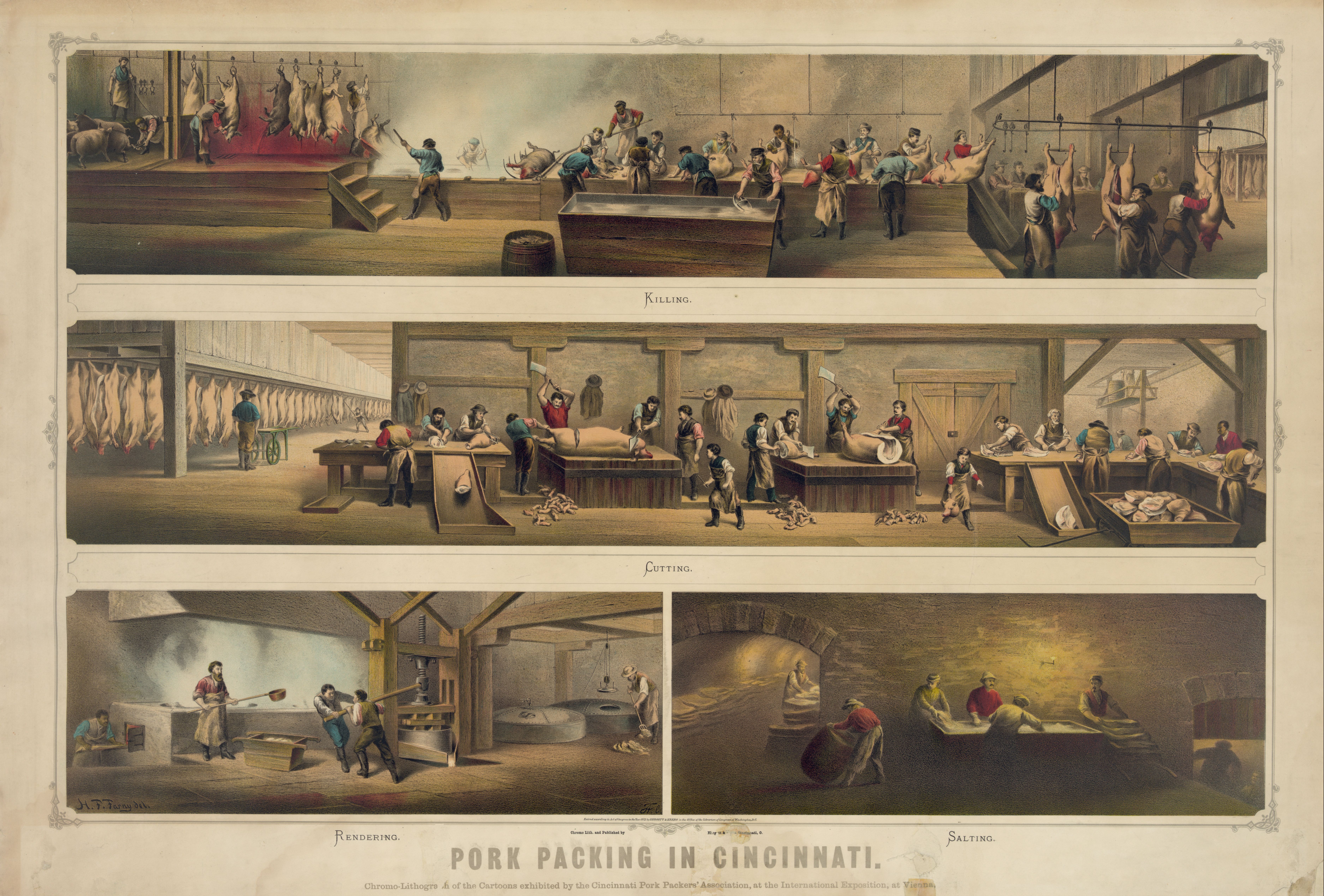
Pork Packing in 1873


For those currently reading Upton Sinclair's The Jungle, this high-quality (and not particularly gruesome) scan of pork packing in Cincinnati might be of interest. I think it's fascinating.

Sunday, 1 March 2009

Paxman's nod to 'Steel City'

Jeremy Paxman's 'The Victorians' (screened this evening on BBC1) included an early reference to Sheffield, whose inhabitants produced half the world's steel in the mid-nineteenth century:

http://www.bbc.co.uk/iplayer/episode/b00hxqr0/The_Victorians_Having_It_All/

For a day in the Steel City, known to locals as Shiny Sheffield, make sure you join the New History Lab trip this Saturday. Congregating at the front of Sheffield station between 11.05 and 11.15, or leaving Leicester on the 10.04 train. I have checked with East Midlands Trains and sadly they aren't prepared to delay for us, so do be there (usually platform 2) by 10.00 with your ticket at the ready!

Allegedly the winter is on its way back this week, so bring your big coat too. Pink wristbands alone may not keep the Yorkshire cold at bay.