
This nice collection of photographs from the Guardian website shows the rise and fall of the Berlin wall. There's been quite a bit about this in the press of late, and I'm a bit slow posting this. One thing which is interesting is that increasingly these web photograph albums are being used in a narrative fashion.
Saturday, 21 November 2009

Friday, 20 November 2009
CfP: Space, Place and Environment: Historical Approaches
Day Conference
6 March 2010, in conjunction with International Women's Week
The Gender in History Group of the University of Southern Denmark invites proposals of papers relating to historical approaches on the theme of 'Space, Place and Environment'. Proposals should be for papers of twenty minutes, and any aspect of the theme will be considered. Contributions from postgraduates are especially encouraged. The conference language will be English.
Papers may address some of the following themes:
City and Country
Domestic and Public Space
Using/abusing the environment
Gendered Spaces
Individual and collective identities
Public history and the use of space (e.g. museums, parks etc.)
Abstracts of 200 words should be submitted to Theresa Jepsen, [email protected] by 15 January 2010.
Long exposure photography: the early years
Judging by the promotional video, the British Library's new exhibition of nineteenth-century photographs looks great. It's also inspired me to begin a series of posts here on the blog about long-exposure photography. More info after the video!
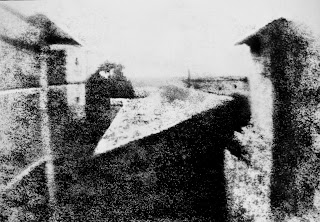
My favourite nineteenth-century photographs are the ones from the early years of the technology's development, when exposures had to be extremely long due to the photographic plates' lack of light-sensitivity. Take View from the Window at Le Gras (1826), for example: the buildings on the left and right are both in full sunlight... because the picture took eight hours to execute!
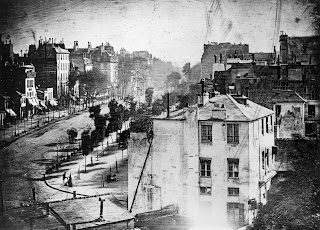
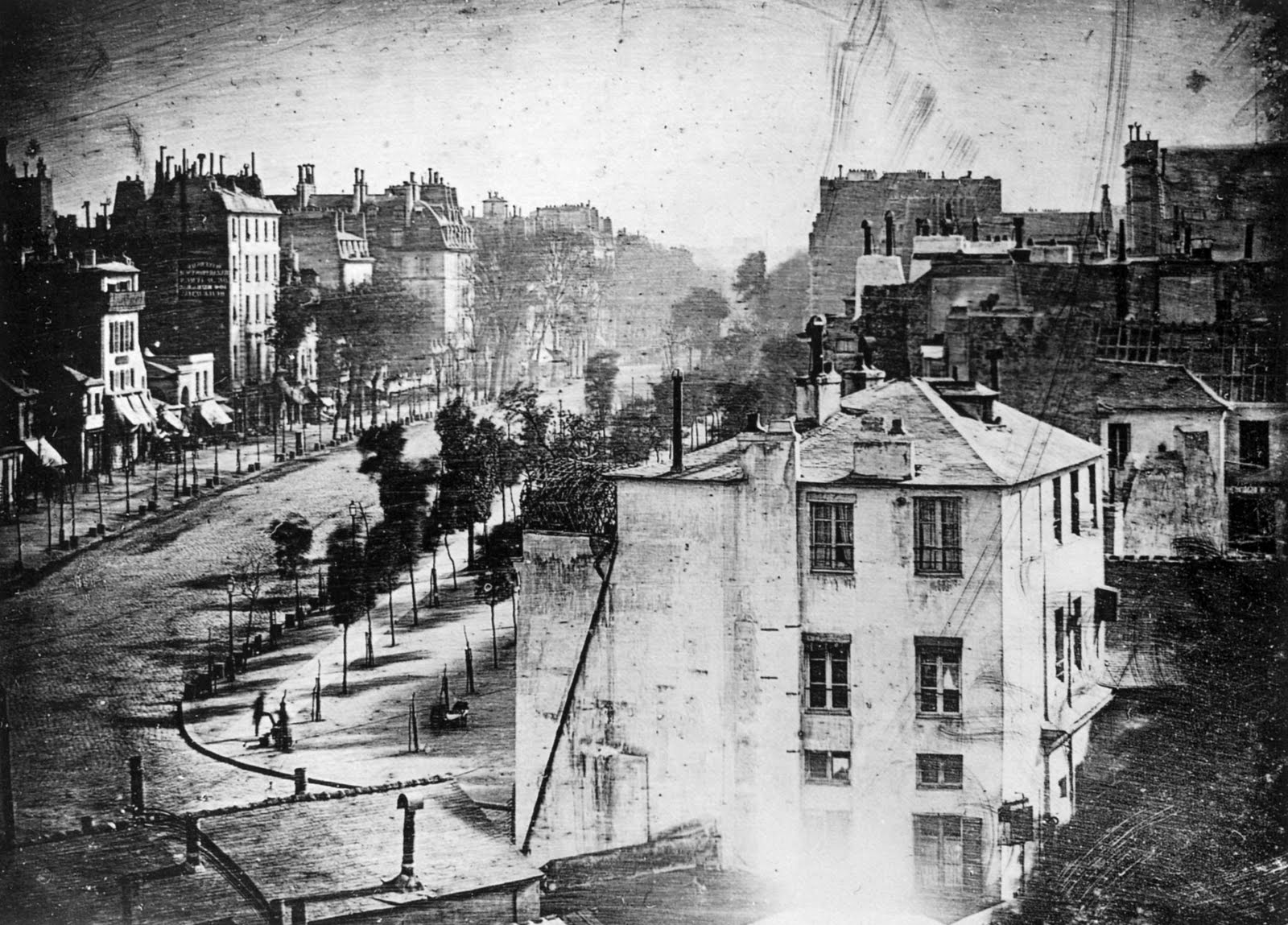
The consequence of this was that pictures of busy scenes like the one below, of the Boulevard du Temple in Paris, show streets devoid of traffic. The ten-minute exposure meant that the constantly-moving people and vehicles became no more than a faint collective blur in the final image. That is, apart from one person: a nameless man who, while having his shoes shined, became the first person in history to have their photo taken.
Come back on Monday at 1.37pm for another installment in my new series of ramblings on long-exposure photography!
My favourite nineteenth-century photographs are the ones from the early years of the technology's development, when exposures had to be extremely long due to the photographic plates' lack of light-sensitivity. Take View from the Window at Le Gras (1826), for example: the buildings on the left and right are both in full sunlight... because the picture took eight hours to execute!

The consequence of this was that pictures of busy scenes like the one below, of the Boulevard du Temple in Paris, show streets devoid of traffic. The ten-minute exposure meant that the constantly-moving people and vehicles became no more than a faint collective blur in the final image. That is, apart from one person: a nameless man who, while having his shoes shined, became the first person in history to have their photo taken.
Come back on Monday at 1.37pm for another installment in my new series of ramblings on long-exposure photography!
Thursday, 19 November 2009
Fire-proof reading
I have a recurrent dream. Well nightmare. I am sure we all have here. Your most treasured books have been irreplaceably lost in a fire. I've never seen another copy of Munro's A Sketch of the Common Good of the City of Aberdeen for sale. The solution is obvious! Print on, and bind in, asbestos. For a snip under £20,000, the Fine Books Company of Rochester are offering a complete set (of two, I hasten to add) science fiction titles printed thus. More details here. This wasn't an archival move, but more of a gimmick. My question is would you need special storage and a mask to prevent the risk of asbestosis, but presumably they'd say if it were a problem. But imagine: it could be the special collections reading room to end all reading rooms! I wonder about the idea if I ever complete my thesis. Of course, if you are not easily inflamed whilst reading, you needn't go to this expense.
CfP: Print Networks Conference 2010
THE BOOK TRADE IN EARLY MODERN BRITAIN
Shakespeare Institute, Stratford-upon-Avon 6-7 July 2010
Guest speakers
BERNARD CAPP, Professor of History, University of Warwick
GILES MANDELBROTE Curator, British Collections 1501-1800, The British Library
The conference theme is broadly defined and papers are invited on any aspect of the production, distribution and reception of print and manuscript in late medieval and early modern Britain, up to c.1750, and on aspects of book-trade relations within the Anglophone world.
Papers should be of up to 30 minutes' duration. A brief CV (c. 50 words) and an abstract (of c.300 words) should be submitted by 28 February 2010 to John Hinks: [email protected]. Selected papers will be published as part of the Print Networks series, edited by John Hinks and Matthew Day, published by Oak Knoll Press and the British Library.We can offer up to two Conference Fellowships to postgraduate students who wish to present a paper. Fellowships cover the cost of attending the conference and assistance towards costs of travel. An outline of the research being undertaken, together with a letter of recommendation from a tutor or supervisor, should be sent by 28 February 2010 to John Hinks: [email protected]
For the latest information on the conference visit the British Book Trade Index website: www.bbti.bham.ac.uk (then select 'Print Networks').The conference (earlier in July than usual) will be held over two full days. We shall meet in the attractive surroundings of the Shakespeare Institute, Stratford-upon-Avon. Delegates will need to book their own overnight accommodation, of which there is a wide choice in Stratford.
Conference organizer (on behalf of the 'Print Networks' committee): Dr John Hinks, Centre for Urban History, University of Leiceste,r Leicester LE1 7RH.
A spoonful of Gradschool makes the medicine go down...
So having been back from GRADschool (http://www.vitae.ac.uk/researchers/15672/GRADschools.html) for about a week now and the buzz still keeping me going at 100mph. I figured I should take the time to share the experience with you all.
As a third year PhD student I often find myself wondering about life outside the research, why people don't seem to care so much about the minutiae of 18th century urban colonies, and, how knowing the exchange rate of pounds to rupees in 1727 will ever net me my dream job. So following recommendations from several tutors and the hearty recommendation of my research council I signed up and took the short trip to Scalford Hall (reputedly the location and inspiration behind Cleudo - a house owned by a Colonel Coleman of English Mustard fame).
The next three days went by in a blur, but, I do remember several key events that made the experience a useful and enjoyable event.
Overthe course of the school we participated in several case study/role play exercises whereby we had to explore the way that real world events often unfold. So, one minute, being a chemical company that was looking to protect its profits, to next acting as a group looking to solve the problems of teenage pregnancy. Over the course of three days were pushed far outside our comfort zones. A pessimist might argue that these random examples might not hold any relevance but as an eternal optimist I'd like to take the opposite approach. These types of activities are great ways to gain confidence and to display those o' so important transferable skills that we are taught throughout our studies. Additionally, they are great in helping you understand how you might deal with situations when confronted with them personally, rather than separated from them via historical distance.
One of the major activities that came from the 4 days was the introduction to Myers-Brigg's Type Indicators (MBti for short) which we were introduced to as a form of understanding that different ways of working do not necessarily mean wrong ways of working. Though, being told that as a unique individual you are possibly similar in character to somebody else can be a bit disturbing, it did seem to have some practical uses.
Your personality type could be one of sixteen combinations and no one type is wrong or superior to another. The use of these tests and talks about MBti was that it really made me feel like I should stop worrying about whether I was working to please my superiors but whether I was working to get the job done. It gave me great comfort to know that though I may not be the consummate planner, that it is not criminal to be a little more flexible with your time than someone else (politeness and common courtesy permitting of course). As an example of this, one of my favourite activities is to just turn up in a place and explore, not have each step of the journey planned out in particular detail, but to really enjoy the freedom of letting your feet take you somewhere new. Equally, I now appreciate that some of you reading this will be shuddering over your tea and cake proclaiming me as a blasphemer against organised culture or even efficiency. But if going away to GRADschool has taught me one thing, its that that's ok.
So if your just starting a PhD or thinking that you could do with some perspective on what you'd lived, breathed and slept for a year or two. Maybe have a look at GRADschool and leave that comfort zone, even for a few hours. It'll make the remaining task ahead of you easier to swallow.
p.s my discussion of MBti is deliberately brief, its far to complex for a blog post - check it out at Wikipedia or even go to the Leicester Career people that by all accounts offer some information regarding the use of MBti.
As a third year PhD student I often find myself wondering about life outside the research, why people don't seem to care so much about the minutiae of 18th century urban colonies, and, how knowing the exchange rate of pounds to rupees in 1727 will ever net me my dream job. So following recommendations from several tutors and the hearty recommendation of my research council I signed up and took the short trip to Scalford Hall (reputedly the location and inspiration behind Cleudo - a house owned by a Colonel Coleman of English Mustard fame).
The next three days went by in a blur, but, I do remember several key events that made the experience a useful and enjoyable event.
Overthe course of the school we participated in several case study/role play exercises whereby we had to explore the way that real world events often unfold. So, one minute, being a chemical company that was looking to protect its profits, to next acting as a group looking to solve the problems of teenage pregnancy. Over the course of three days were pushed far outside our comfort zones. A pessimist might argue that these random examples might not hold any relevance but as an eternal optimist I'd like to take the opposite approach. These types of activities are great ways to gain confidence and to display those o' so important transferable skills that we are taught throughout our studies. Additionally, they are great in helping you understand how you might deal with situations when confronted with them personally, rather than separated from them via historical distance.
One of the major activities that came from the 4 days was the introduction to Myers-Brigg's Type Indicators (MBti for short) which we were introduced to as a form of understanding that different ways of working do not necessarily mean wrong ways of working. Though, being told that as a unique individual you are possibly similar in character to somebody else can be a bit disturbing, it did seem to have some practical uses.
Your personality type could be one of sixteen combinations and no one type is wrong or superior to another. The use of these tests and talks about MBti was that it really made me feel like I should stop worrying about whether I was working to please my superiors but whether I was working to get the job done. It gave me great comfort to know that though I may not be the consummate planner, that it is not criminal to be a little more flexible with your time than someone else (politeness and common courtesy permitting of course). As an example of this, one of my favourite activities is to just turn up in a place and explore, not have each step of the journey planned out in particular detail, but to really enjoy the freedom of letting your feet take you somewhere new. Equally, I now appreciate that some of you reading this will be shuddering over your tea and cake proclaiming me as a blasphemer against organised culture or even efficiency. But if going away to GRADschool has taught me one thing, its that that's ok.
So if your just starting a PhD or thinking that you could do with some perspective on what you'd lived, breathed and slept for a year or two. Maybe have a look at GRADschool and leave that comfort zone, even for a few hours. It'll make the remaining task ahead of you easier to swallow.
p.s my discussion of MBti is deliberately brief, its far to complex for a blog post - check it out at Wikipedia or even go to the Leicester Career people that by all accounts offer some information regarding the use of MBti.
Wednesday, 18 November 2009
Sound Archives, Dialects and Language
I have been looking around the British Library's Archival Sound Recordings Project Blog and there is some great stuff on there, everything from South African bird song to Indian wedding music. The fairly new blog Voices of the UK is also an intersting read and looks at the Library's audio collections of British accents and dialects. As those of you who came to the Lab's session on slang know this is a really interesting area. The BBC also has it's Voices website, which is no longer updated, but has some great stuff if you are interested in regional language and the use of English and languge in Britain.
Tuesday, 17 November 2009
The sins of the fathers.
"They fuck you up, your mum and dad", begins Larkin's infamous These be the verse. Barbara Cherish knew her father had done something terrible in the war, but not quite what. It was something of a taboo subject. It was only after a good deal of research that she discovered that he was Auschwitz's Kommandant, and had been tried and executed for war crimes. She's written a book dealing with discovering and coming to terms with this chilling revelation, which has been published by the History Press. You can also read a short interview with her here.
Broadside ballads, World War One, and History 2.0
Nobody could ever suggest that urban history doesn't take one to glamorous places. I was at a Curatorial Roundtable on Digitizing Broadside Ballads at the Bodleian last Friday. There were some really interesting ideas flying around, with contributions from senior staff from the Bodleian, librarians from across Europe, and yours truly, amongst a group of others. Alongside serious discussion about the problems facing digitization of these remarkable sources, we heard from those responsible for some major digitization projects at the Bodleian. This includes the Digital John Johnson collection, the originals of which live in the Bodleian. with which I was already familiar, and the First World War Poetry Archive, including the user-submitted Great War Archive, with which I was not. Blimey! This might be the best website I've ever seen. (Other than the present blog, naturally). Log on, even if you do not have one modicum of interest in this thing. They have some great resources. Everything you consider possible for a historical or archive website, they've done. Digitization, background materials, educational resources for every level from key stage one to university, twitter, facebook, forums, second life and more. This is really a lesson in what I would like to call History 2.0 ought to be done. They've even got a community forum which is outliving the funded element and people submitting material via Flickr.
Monday, 16 November 2009
Whisky galore
Whisky Galore is one my favourite black and white films. However the link is only tangential. Researchers are going to dig up two crates of Shackleton's whisky from his hut in the Antarctic o be restored and replaced. Museum conditions can be harsh, but this must be exceptional! White and Mackay are keen to get a sample and recreate this now long-forgotten blend. Historical drinkies? We'll drink to that. More at the BBC.
Sunday, 15 November 2009
Clinic Session 20th November
Just a reminder about the Clinic session on Friday, please send in your questions/problems for the session. [email protected]
Emma Kimberly from the library and organiser of the Thesis Workshop will be coming along as well as Evelyn Cornell from the library. We also hope that staff and students in the room will provide their expertise.
This is a session for all you wonderful labbers and will be shaped by whatever you bring along.
This is a session for everyone, so no matter what your postgrad question or problem, get in touch!
You can also get in touch via this blog, Facebook and Twitter.
Emma Kimberly from the library and organiser of the Thesis Workshop will be coming along as well as Evelyn Cornell from the library. We also hope that staff and students in the room will provide their expertise.
This is a session for all you wonderful labbers and will be shaped by whatever you bring along.
This is a session for everyone, so no matter what your postgrad question or problem, get in touch!
You can also get in touch via this blog, Facebook and Twitter.
Subscribe to:
Posts (Atom)

 Posts
Posts



