
Anne Lister (1791-1840) was an openly lesbian, member of the Yorkshire landed gentry.
Quotes from her diary include "I love and only love the fairer sex and thus beloved by them in turn, my heart revolts from any love but theirs." and "Yet my manners are certainly peculiar, not all masculine but rather softly gentleman-like. I know how to please girls." (translated by Olive Anderson for the History Workshop Journal in 1995. Lister was credited with astonishing self-awareness and independent spirit for a woman of her standing and situation.
Her diary reveals that she liked to be called 'Fred' or 'Gentleman Jack' by her lovers, one of which included a wealthy local heiress, Ann Walker. Their affair and eventual marriage was moulded into local folklore and fireside tales.
If this has whetted your appetite for Lister-y lesbian loving, then you'll be happy to hear that any day now, BBC 2 is airing a 90-minute drama/biopic called 'The Secret Diaries of Miss Anne Lister', with Maxine Peake in the title role. More info here
Thanks to Sandra for the heads-up!
Saturday, 13 February 2010

Labcast 4: Transcending the Boundaries: Cathryn Enis - Material culture and early modern kinship networks
The second New History Labcast. Thanks to Colin Hyde, Terese Bird and all at the BDRA/Graduate School Media Zoo for making, posting and hosting the mp3 files. Do all please enjoy.
Cathryn Enis (Reading)
Using material culture to recreate Early Modern kinship networks and political alliances - sources, controversies and recovering affective significance.
Download it here, from the Graduate School Media Zoo website.
Friday, 12 February 2010
The LGBT History Series (12) - Adolf Brand
Adolf Brand (1874-1945) was a german anarchist and campaigner, an early advocate of bisexuality and homosexuality, and producer of the first homosexual periodical, 'Der Eigene', started in 1896.
Brand was influenced by ideas of individualism and self-ownership and the revival of Ancient Greek pederasty as a cultural model for modern homosexuality.
In 1899, Brand published an anthology of homoerotic literature and in 1903, formed the 'Gemeinschaft der Eigenen' organisation (roughly translated as 'the community of the self'), which fore-fronted ideas like male-male love being an aspect of all masculinities, rather than a gay being a specific type of person.
Brand was famous at the time for 'outing' politicians who practised homosexuality whilst preaching anti-homosexuality, most notably in 1907 that the German Chancellor, von Bulow had a long-standing relationship with Privy Councillor Scheefer.
Adolf Brand had to give up homosexual activism in the 1930s after harrassment from the Nazis, who silenced 'Der Eigene', destroyed his lifes works, and left him in financial ruin, as well as razing the Institut fur Sexualwissenschaft.
For pictures, see here
Brand was influenced by ideas of individualism and self-ownership and the revival of Ancient Greek pederasty as a cultural model for modern homosexuality.
In 1899, Brand published an anthology of homoerotic literature and in 1903, formed the 'Gemeinschaft der Eigenen' organisation (roughly translated as 'the community of the self'), which fore-fronted ideas like male-male love being an aspect of all masculinities, rather than a gay being a specific type of person.
Brand was famous at the time for 'outing' politicians who practised homosexuality whilst preaching anti-homosexuality, most notably in 1907 that the German Chancellor, von Bulow had a long-standing relationship with Privy Councillor Scheefer.
Adolf Brand had to give up homosexual activism in the 1930s after harrassment from the Nazis, who silenced 'Der Eigene', destroyed his lifes works, and left him in financial ruin, as well as razing the Institut fur Sexualwissenschaft.
For pictures, see here
Science Museum Junior Research Fellowships
From Sally Horrocks.
Bursary £1,000 a month
This is an exciting opportunity to carry out research on the unparalleled collections of the Science Museum, London. To mark the centenary of its founding as an independent museum in 1909, the Science Museum is offering two (2)
junior research fellowships to enable postgraduate students explore the riches of its scientific, technological and medical collections and the Science Museum Library.
The Science Museum has the largest and most significant collections relating to science, technology and medicine. With over 300,000 objects in its care, the Science Museum has particular strengths in the history of western science, technology and medicine since 1700. This collection is supported by the books, journals and archives which are available in the Science Museum Library.
The Science Museum's research programme has the aim of promoting scholarly research which furthers our understanding of the development of science and technology. The museum is not constrained by disciplinary boundaries and welcomes applications from students from any appropriate subject areas. Applicants are at liberty to propose any theme which sheds light on the Science Museum's collections. The precise topic will be chosen by the Science Museum in order to make the best use of the Science Museum's collections while taking into account the
successful candidate's educational background, interests and strengths.
The bursary for this Junior Research Fellowship is £1,000 per month for up to three months and is intended to cover travel to and from the museum and living expenses. There will be very limited funds available to cover exceptional research costs, agreed in advance.
The exact timing of the fellowship will be by arrangement, but will take place between July 2010 and March 2011.
Applicants should send their curriculum vitae, which should show the candidate's education, qualifications and any publications, with a covering letter, which should give a brief explanation of how this fellowship would advance your academic development and why you wish to carry out research on the Science Museum's collections, preferably by email. Please supply the names and addresses of two academic referees. Applicants should send a copy of their application to their chosen referees before submission, asking their referees to comment on their suitability for this Junior Research Fellowship. They should ask their referees to send their references in confidence directly to the address below
- preferably by email
- by Friday 19th March 2010. As there will not be a formal interview, applicants should ensure that they provide all the information needed to make a decision.
The deadline for applications is Friday 12th March 2010.
They should be sent to [email protected] or to:
Dr Peter J T Morris
Head of Research
Science Museum
London SW7 2DD
All candidates will be informed by email if they have been successful by the end of April 2010. Please ensure you include a current email address with your application.
If you have any queries (or need any additional information) please contact Peter Morris.
Labcast 3: Transcending the Boundaries: Catherine Mogg - Sisters doing it for themselves
The latest New History Labcast. Thanks to Colin Hyde, Terese Bird and all the BDRA/Graduate School Media Zoo for making, posting and hosting the mp3 files. Do all please enjoy.
Caroline Mogg (Lincoln)
''Sisters are doing it for themselves...'': reconstructing the unmarried woman in nineteenth century England.
Download it here, from the Graduate School Media Zoo website.
Thursday, 11 February 2010
Labcast 2: Transcending the Boundaries: Geoff Mead - Brighton’s Downland homes
The second New History Labcast. Thanks to Colin Hyde, Terese Bird and all at the BDRA/Graduate School Media Zoo for making, posting and hosting the mp3 files. Do all please enjoy.
Geoffrey Mead (Sussex)
'Scattered squalor' and 'Downlandhomes': Brighton's interwar suburbia
Download it here, from the Graduate School Media Zoo website.
Resilience
Ahead of the NHL session tomorrow afternoon, here are some thoughts on 'Resilience' from our headline speaker, Richard Hall:
"Rob Hopkins, founder of the Transitions movement, argues that resilience is “the capacity of a system to absorb disturbance and reorganise while undergoing change, so as to retain essentially the same function, structure, identity and feedbacks”. He focuses upon the local and the historic, and demands that we empower people to become self-organising. The key for Hopkins is that resilience is more crucial than sustainability - we need to be able to manage shock or disruption or vulnerability, and then find alternatives. This means that the local is as vital as the global. It also means that civil action rather than political action is the key to enfranchisement."
As a History researcher and lecturer, Richard will be analysing the role of the historian in this context. Please feel free to add your comments, here and/or at the lab meeting.
Tomorrow afternoon we will also bring you updates on the peregrination and the Mystery Guest Lecture, as well as a University of Leicester perspective on 'Resilience and History' from our very own distinguished historian and Honorary Visiting Fellow, Siobhan Begley. Please join us at 4.30 for tea and cake!
"Rob Hopkins, founder of the Transitions movement, argues that resilience is “the capacity of a system to absorb disturbance and reorganise while undergoing change, so as to retain essentially the same function, structure, identity and feedbacks”. He focuses upon the local and the historic, and demands that we empower people to become self-organising. The key for Hopkins is that resilience is more crucial than sustainability - we need to be able to manage shock or disruption or vulnerability, and then find alternatives. This means that the local is as vital as the global. It also means that civil action rather than political action is the key to enfranchisement."
As a History researcher and lecturer, Richard will be analysing the role of the historian in this context. Please feel free to add your comments, here and/or at the lab meeting.
Tomorrow afternoon we will also bring you updates on the peregrination and the Mystery Guest Lecture, as well as a University of Leicester perspective on 'Resilience and History' from our very own distinguished historian and Honorary Visiting Fellow, Siobhan Begley. Please join us at 4.30 for tea and cake!
The LGBT History Series (11) - Homosexuality and the Bible
We're going to get a bit contentious now, so hold on to your bonnets boys and girls!
Homosexuality and the Bible is a site dedicated to highlighting different cases of queer interaction that have gone unappreciated or unnoticed so far in and around the christian holy text. Considering the same source has been used for centuries to discriminate against and prejudge queer cultures, its also a lesson in how a historical source can be evaluated in a variety of different ways to come to different answers.
With topics ranging from 'Finding a Christian Gay Ethic' to 'the harmful lies and deceptive claims of the ex-gay movement', as well as referencing characters, places and themes within the Bible, like Jonathon and David, and revisiting Sodom; and especially interesting 'Jesus and his Beloved Disciple' the site is a refreshingly pro-gay, christian stream of opinion, interpretation and knowledge.
Hooray for cheerful pro-gay religious people.
Homosexuality and the Bible is a site dedicated to highlighting different cases of queer interaction that have gone unappreciated or unnoticed so far in and around the christian holy text. Considering the same source has been used for centuries to discriminate against and prejudge queer cultures, its also a lesson in how a historical source can be evaluated in a variety of different ways to come to different answers.
With topics ranging from 'Finding a Christian Gay Ethic' to 'the harmful lies and deceptive claims of the ex-gay movement', as well as referencing characters, places and themes within the Bible, like Jonathon and David, and revisiting Sodom; and especially interesting 'Jesus and his Beloved Disciple' the site is a refreshingly pro-gay, christian stream of opinion, interpretation and knowledge.
Hooray for cheerful pro-gay religious people.
Wednesday, 10 February 2010
Leicester Library Consultation
Really important - please read the link and fill in the survey if you live in Leicester and want to have a say in the planned changes to the City Library.
http://consultations.leicester.gov.uk/ConsDetails.aspx?consID=318
http://consultations.leicester.gov.uk/ConsDetails.aspx?consID=318
Inaugural tonight
Not to distract from the mild hysteria building up ahead of Friday's Resilience workshop. Or from the euphoria as Marcel becomes a published rodent (you don't often see a hamster in annual report), but there's a further event to tickle you pink this evening. Dr Kimberley, a regular attendee of the New History Lab, is giving hers tonight on After 9/11: Representation in a Climate of Fear. If that's too modern, fear not, as the she's double-billed with Claire Strachan on Congregation and Community: Space, Architecture, and Identity in the South West Woollen Industry, c.1760-1860. What a treat.. Ken Edward's Lecture Theatre 3, 5:30pm. Usually last about an hour, and there's free booze after. Online check-in is open here. Officially one ought to register, and it'd be better if you did, but I am confident that the mere mention of the New History Lab will be more than enough to secure admittance.
The LGBT History Series (10) - Princess Serafina
(most of the info for today's blog is shamelessly stolen from the Georgian London blog, thanks guys :D)
Picture the scene, the year: 1732, the place: a Picadilly alehouse. John Cooper swans in dressed as his outrageous alter-ego, Princess Serafina. London's first recorded transvestite was a 'fixer' for queer society, he arranged meetings between rich men and their male conquests.
In the witness box, after Cooper was put on trial for accusations of "Buggery", a local laundress, Jane Jones repeatedly referred to Cooper/Serafina as "she", and was "sad that a simple case of Sodomity, whatever that is, had come to court".
Another witness said "Her highness ... us'd to come to my house to enquire after some Gentlemen ... I have seen her in Women's Cloaths ... a white Gown, and a scarlet Cloak ... she would so flutter her fan ... She takes great Delight in Balls and Masquerades ... dancing with fine Gentlemen."
The widespread acceptance of Serafina/Cooper in her preferred character, whilst heart-warming was probably unique in this period - he made his living as a nurse (a uniformly female occupation in this period); regularly wore women's clothes, and was tolerated by his home community, who clearly didn't see transvetitism or "Sodomity" as that much of a big deal.
Picture the scene, the year: 1732, the place: a Picadilly alehouse. John Cooper swans in dressed as his outrageous alter-ego, Princess Serafina. London's first recorded transvestite was a 'fixer' for queer society, he arranged meetings between rich men and their male conquests.
In the witness box, after Cooper was put on trial for accusations of "Buggery", a local laundress, Jane Jones repeatedly referred to Cooper/Serafina as "she", and was "sad that a simple case of Sodomity, whatever that is, had come to court".
Another witness said "Her highness ... us'd to come to my house to enquire after some Gentlemen ... I have seen her in Women's Cloaths ... a white Gown, and a scarlet Cloak ... she would so flutter her fan ... She takes great Delight in Balls and Masquerades ... dancing with fine Gentlemen."
The widespread acceptance of Serafina/Cooper in her preferred character, whilst heart-warming was probably unique in this period - he made his living as a nurse (a uniformly female occupation in this period); regularly wore women's clothes, and was tolerated by his home community, who clearly didn't see transvetitism or "Sodomity" as that much of a big deal.
Tuesday, 9 February 2010
The LGBT History Series (9) - Alan Turing
Alan Mathison Turing (1912-1954) was a cryptanalyst and computer scientist who worked at the Bletchley Park code-breaking centre during the Second World War. He devised the machine that worked out the algorithms to which the german enigma machines had been set, so that the allies could decode message ciphers. Without him, its a fair bet to say that Britain would've lost the war.
Turing's homosexuality resulted in a criminal prosecution in 1952 and he was treated with female hormones and chemical castration.
Two years later, Turing died from an allegedly self-administered cyanide overdose in an apple.
Since his death, Turing's heroic status has been recognised in a variety of different capacities, Manchester University named a building after him, and unveiled a statue in memorial of him in Sackville Park off Canal Street. Kings' College Cambridge named their Computer Department after possibly their most valuable alumnus, and there are numerous awards worldwide that are named after Turing. The logo of the 'apple' company (ipods, ipads and macbooks, not Beatles records) is supposed to pay homage to Alan Turing as a pionerring computer scientist, with the bitemark as a nod towards his suicide but the company denies these claims. In 2009, Gordon Brown acknowledged a petition to apologise for the British Government's treating of Turing as a homosexual.
Turing's homosexuality resulted in a criminal prosecution in 1952 and he was treated with female hormones and chemical castration.
Two years later, Turing died from an allegedly self-administered cyanide overdose in an apple.
Since his death, Turing's heroic status has been recognised in a variety of different capacities, Manchester University named a building after him, and unveiled a statue in memorial of him in Sackville Park off Canal Street. Kings' College Cambridge named their Computer Department after possibly their most valuable alumnus, and there are numerous awards worldwide that are named after Turing. The logo of the 'apple' company (ipods, ipads and macbooks, not Beatles records) is supposed to pay homage to Alan Turing as a pionerring computer scientist, with the bitemark as a nod towards his suicide but the company denies these claims. In 2009, Gordon Brown acknowledged a petition to apologise for the British Government's treating of Turing as a homosexual.
A slice of cake with your history?
If you aren't a keen subscriber already, the University's Annual Report is now out, featuring a super bit on the New History Lab. In pink. And our furry friend is featured. Select the 2008/9 Annual report, and turn to pages 12 and 13 in the PDF. A big thank you to Jane Pearson for such a super piece.
Monday, 8 February 2010
The LGBT History Series (8) - Mlle Raucourt
Françoise Marie Antoinette Saucerotte (1756-1815), also known as Madamoiselle Raucourt, was an incredibly beautiful and talented actress and singer, from an early age in Spain, and in the court of Marie Antoinette in France, which made her famous. What made her infamous were her entirely un-hidden love affairs with women and men, most notably with French opera-soprano Sophie Arnould. The relationship ended badly, and two male friends represented the women in a duel to the death.
Whilst able to live happily as a lesbian in court and theatrical circles, hostile and libellous pamphlets were published against her, claiming she was the head of the 'Sect of Anandryne', a Parisian society of man-hating lesbians which may or may not have even existed. After the French Revolution, Saucerotte became Napoleon's director of imperial theatres in Italy.
When she died, the rector of Saint-Roch church refused to admit her body. A riot erupted among the amassed crowd of fifteen thousand people and the doors to the church were forced to carry Françoise in for her requiem mass, accompanied by an order from the King directing the priest to perform it.
After Saucerotte's funeral, her brother helped to organise a lifetime income for her partner, Henriette Simonnot de Ponty, and she assumed the lease of the couple's house.
Whilst able to live happily as a lesbian in court and theatrical circles, hostile and libellous pamphlets were published against her, claiming she was the head of the 'Sect of Anandryne', a Parisian society of man-hating lesbians which may or may not have even existed. After the French Revolution, Saucerotte became Napoleon's director of imperial theatres in Italy.
When she died, the rector of Saint-Roch church refused to admit her body. A riot erupted among the amassed crowd of fifteen thousand people and the doors to the church were forced to carry Françoise in for her requiem mass, accompanied by an order from the King directing the priest to perform it.
After Saucerotte's funeral, her brother helped to organise a lifetime income for her partner, Henriette Simonnot de Ponty, and she assumed the lease of the couple's house.
Sunday, 7 February 2010
The LGBT History Series, (7) - Pope condemns UK equality Laws
A bit of current affairs for you now. Last week the Guardian reported that Pope Benedict XVI had spoken to a collection of Bishops from England and Wales recently, in preparation for his planned visit on 16th-19th September this year.
Ben (as I like to call him) was concerned that the UK's equality laws 'threatened religious freedom' and 'ran contrary to natural law', which to me sounds like it could be taken as just a tad homophobic, considering the recent kerfuffle over catholic adoption agencies illegally discriminating against gay couples. The other affect that the equality laws have on catholicism is that they make it harder for churches to exclude job applications from gay people and people who've changed their gender. It'll be interesting to see whether the visit runs smoothly or not...
The National Secular Society is already planning its protests around the Pope's visit, pointing out that the state will be presented with a £20 million bill for an old man to visit and complain about equal rights and promote discrimination
Ben (as I like to call him) was concerned that the UK's equality laws 'threatened religious freedom' and 'ran contrary to natural law', which to me sounds like it could be taken as just a tad homophobic, considering the recent kerfuffle over catholic adoption agencies illegally discriminating against gay couples. The other affect that the equality laws have on catholicism is that they make it harder for churches to exclude job applications from gay people and people who've changed their gender. It'll be interesting to see whether the visit runs smoothly or not...
The National Secular Society is already planning its protests around the Pope's visit, pointing out that the state will be presented with a £20 million bill for an old man to visit and complain about equal rights and promote discrimination
Drinkable histories of exploration
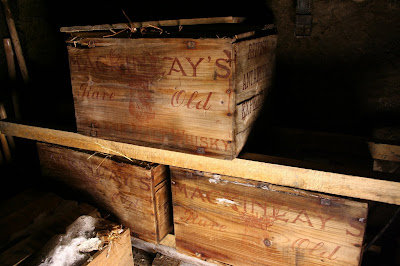
Mackinlay's Whisky. Credit: NZAHT.org
Robyn's splendid post yesterday may have whetted your appetite for histories of exploration. Well you wash all that food for thought down with an update on the Shackleton whisky. In November I posted here details of an attempt to extract some of Shackleton's whisky, and, hopefully, recreate the stuff. There's some details on a Guardian blog. Whyte and Mackay, responsible for the original stuff, are keenly interested in the development: no small wonder, as there could be a serious market for this: the history nerds, alcoholics, and explorers would be queued up down the street to buy it by the case. Which, coincidentally, I hope they ship in wood. Their Master blender, Richard Paterson, speculated it might taste 'Cold', and there's a video on his blog too, of the whisky. Finally, a thoughtful piece can be found on the California Academy of Sciences blog, of an expedition to visit the hut, with beautiful images too.
It's still some time off, as they've still got to recreate and produce and bottle the stuff. That said, it's a blend, so when they know what goes in it, it could be on the market fairly sharpish. Hopefully sensibly-priced, but more likely to hit around the £70-90 price mark in some kind of fancy historical packaging, would be my guess. I hope I'm proved wrong.
However arduous the work may seem, when the Lab gets hold of a bottle of the recreation, we'll post very full tasting notes. I personally undertake to do this. Promise! Perhaps historical drinkies could make a good Lab session next year. Does that tickle your fancy?
Subscribe to:
Posts (Atom)

 Posts
Posts



