Friday, 25 December 2009

Advent 25: the Clocktower


As the world and its dog knows, the centre of the known universe is the clocktower in Leicester. This piece of High Gothic-ness was the winner of a competition in 1868 to create a centre piece for the newly cleared area just outside the site of the city's ancient East Gates. The site of trading and fairs for centuries, this became the centre of Leicester. From 1904-1949 electric trams ran round the clocktower, traffic choked the area for decades, but this year has finally seen the area almost completely pedestrianised.
However, the clocktower is not always the centre of civic merriment and this Christmas and New Year's Eve you will find people celebrating in the Town Hall Square as well as around the clocktower. Wherever you end up, a very Merry Christmas and a Happy New Year!

Thursday, 24 December 2009

A return to a less commercial Christmas?

The polemical call for a return to a more proper, wholesome Christmas, without the commerce and shopping, is not a new thing. There was a rather nice editorial piece in yesterday's FT, calling for less history, with a short historical survey of Christmas celebrations, eschewing all the spending from which, presumably, many of its readers make heaps of cash. Quite refreshing, especially within a fairly jaded genre.

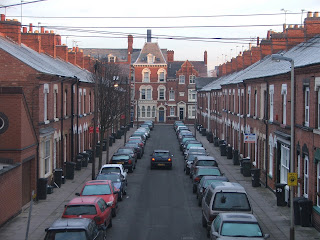
Advent 24: Streets


This photo shows Churchill Street, Leicester. Here you see red brick Victorian terraced houses of the late 1880s to the left and right, while at the end is a larger terraced property from the 1870s. The street is packed with cars; telephone lines and television aerials run across the top of the picture, there are wheelie bins all along the pavements. To complete this scene of a modern city street the only things which are missing are satellite dishes (not allowed in what was until recently a conservation area) and traffic calming measures.

It was an interest in streets such as these that prompted me to buy a camera and start taking photographs. After a while one's eye develops and things which had previously not been noticed reveal themselves to the lens. Then, if you're like me, you create a wesbite. If you haven't already, have a look at the delights of terraced houses here: http://www.le.ac.uk/emoha/leicester/terraces.html

Wednesday, 23 December 2009

Advent 23: New Walk


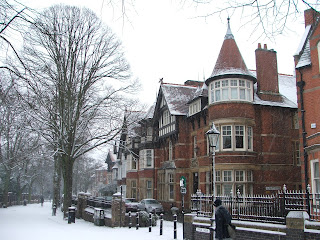
For those of us who work close to New Walk it can be easy to take theis gem of Leicester for granted. It was laid out in 1785 but was still a path through fields in 1804. Today it remains a pedestrian-only path (despite the herds of cyclists) and is part of the New Walk Conservation Area. When he arrived as Leicester's Chief Planning Officer in the 1960s Konrad Smigielski declared Leicester to be 'drab' and 'depressing' but found a glint of hope in New Walk, and thanks to him it became one of the very earliest conservation areas. The picture shows the top of New Walk which was developed in the 1880s, later than the northern section. A full description of everything to do with New Walk can be found here: http://www.leicester.gov.uk/your-council-services/ep/planning/designandconservation/conservationareas/conservationareasleicester/new-walk/

Tuesday, 22 December 2009

Advent 22: Celebrations


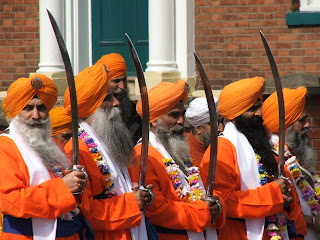
Leicester's immigrant population has changed the city is many ways. For example, places of worship have been built, local politics has been engaged with, and the way we celebrate and commemorate has changed. Diwali, Vaisakhi, Eid, Caribbean Carnival etc. are all now celebrated on the streets of Leicester. Vaisakhi is a long established harvest festival in the Punjab and the men in the photo are known as the Panj Piare, or 'Beloved Five', after five men who answered a challenge of Guru Gobind Singh (do they need a special licence for the swords?!).

Monday, 21 December 2009

Advent 21: Plaques (2)


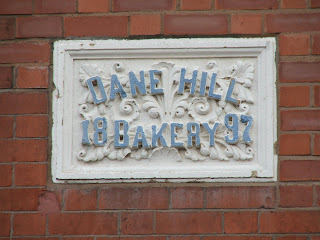
As we have seen, large Victorian houses often sported ornate plaques, but even small houses often had a plaque of some sort declaring the date of the house, the name, or sometimes both as in the example above. In a study of plaque names done at the Centre for Urban History it was found that while there were plenty of examples of names of flowers and coastal resorts (so the urban dweller would have at least a hint of the rural about their home), there were also many names which reflected current political figures and events, such as the South African conflicts. It was suggested that this resulted in a subtle reminder of authority and empire being present in even the humblest of streets. More examples can be found here: http://www.le.ac.uk/emoha/leicester/plaques.html

Sunday, 20 December 2009

Advent 20: the Statue of Liberty


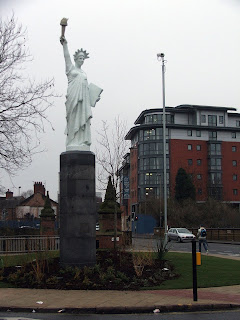
What on earth is a copy of the Statue of Liberty doing on a roundabout in Leicester? Well, the large building in the background (student flats) replaced a factory which was originally called Lennards Shoes. In 1920 the directors of Lennards Shoes visited New York, were impressed by the Statue of Liberty, and on their return to Leicester commissioned sculptor Joseph Herbert Morcom to produce one for their firm, which they named Liberty Shoes.

The statue was placed on top of the building and became a prominent landmark until the building was demolished in 2002. The council stipulated that the statue should be retained and, after much wrangling, it was finally erected on its current spot at the end of 2008. Bizarrely, the plaque on the statue's plinth makes no mention of Liberty Shoes, leaving the newcomer to Leicester with no clue as to why this unlikely scene came to be.