Saturday, 6 February 2010

Hidden Histories of Exploration

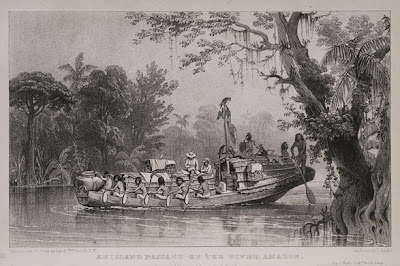
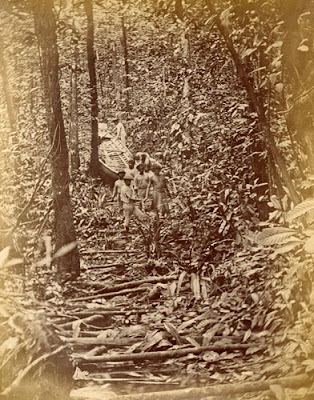
I have read a lot about exploration and travel for my research so was interested to see this photo gallery at the Guardian website looking at the role of the local populations in exploration in the nineteenth and twentieth centuries. The majority of explorers were not alone on their journey into the ‘unknown’, local knowledge and support was vital but for the most part unrecognised in the popular idea of the explorer.

"Local muscle employed on an 1836 journey down the River Amazon, captured in a lithograph in W. Smyth and F. Lowe's Narrative of a Journey from Lima to Para, Across the Andes and Down the Amazon."

"The navigation of rivers in British Guiana required overland transport of boats to bypass cataracts. This photograph was taken in 1878."

The research project is called Hidden Histories of Exploration from the Royal Geographical Society and Royal Holloway, University of London, funded by the AHRC.

Source: The Guardian

The LGBT History Series (6) - 'Queer London' by Matt Houlbrook

Well why not do a bit of a book review, eh?
'Queer London: Perils and Pleasures in the Sexual Metropolis, 1918-1957' to give it a full title is an interesting, indepth look into the re-structuring of the urban spaces of early twentieth century London through a queer perspective.

The book covers everything from policing and agent provocateurs prowling around the public toilets and parks of the west end, to the various public and private places where queer culture was performed and perceived including bathhouses, cottages, and cinemas. Parts three and four look further into the different types of character seen under the umbrella term 'queer' and the cultural politics of 'difference' and the 'other'.

If you read this, and come along to the Lab on the 26th, you'll be clued up on queers from Medieval, through Victorian and right up to the twentieth century. Hooray!

Friday, 5 February 2010

Labcast 1: Transcending the Boundaries: Rob Colls - Introduction

Here is our very first ever New History Labcast. It's from Transcending The Boundaries, and it's Rob's introduction. You can listen as many times as you like!

Download it here, from the Graduate School Media Zoo website. Thanks to BDRA and the Graduate School for this!

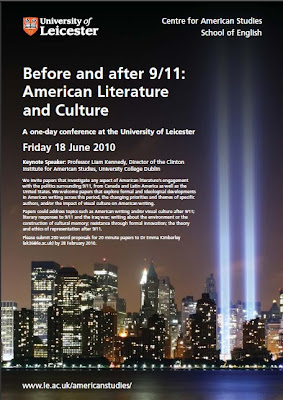
CFP: Before and after 9/11: American Literature and Culture

This looks great - and no travelling required for Leicester Labbers! Arranged by Emma, so you are in safe hands!

Before and after 9/11: American Literature and Culture
A one-day conference at the University of Leicester
Friday 18 June 2010
Keynote Speaker: Professor Liam Kennedy, Director of the Clinton Institute for American Studies, University College Dublin

We invite papers that investigate any aspect of American literature’s engagementwith the politics surrounding 9/11, from Canada and Latin America as well as theUnited States. We welcome papers that explore formal and ideological developmentsin American writing across this period, the changing priorities and themes of specificauthors, and/or the impact of visual culture on American writing.Papers could address topics such as American writing and/or visual culture after 9/11;literary responses to 9/11 and the Iraq war; writing about the environment or theconstruction of cultural memory; resistance through formal innovation; the theoryand ethics of representation after 9/11.Please submit 200 word proposals for 20 minute papers to Dr Emma Kimberley([email protected]) by 28 February 2010.www.le.

Paleography Petition!

http://www.petitiononline.com/spkcl10/petition.html

Following the post above,

Save paleography at KCL!!!

The LGBT History Series (5) - Lesbian Pirates

Anne Bonney and Mary Read were lovers and pirates who sailed the high seas in the early 18th century, Bonney also had relations with the notorious pirate, Calico Jack. One story told about the pair is that after boarding and looting a ship that included a trunk of fancy dresses, their crew (of men) could not resist a most absurd costume dance in celebration. On the horizon appeared another ship worthy of attack. Anne had her cross-dressed men arrange themselves about the ship like corpses. Anne took her next prize without resistance, as she was perceived as not a pirate but a ghost ship.

Of their deaths, not much is known. It is believed that Mary died in prison of pneumonia, but Anne escaped only to be hanged with a group of fanatical nuns over whom she held sway. Anne is reported to have quipped during the final fray of their capture, "Dogs! If instead of these weaklings I only had some women with me!" It is doubtful she meant to be ironic.

There are amp.uk
le resources for Bonney and Read, and Calico Jack, so I'm going to commit historical suicide and refer anyone who's interested in learning more to the wikipedia entry :O

Thursday, 4 February 2010

You don’t know what you’ve got until it’s gone

I'd well imagine that you've already heard about the King's College Palaeography debacle. It's no news that Universities are really starting to feel the pinch recession wise. Worse is to come. But at King's College, London, something rather special is under threat: the UK's only chair in palaeography is allegedly in line to be axed. This is a higher order skill than the squinting funnily at manuscripts and proclaiming "aah! It's a 'g'" which we all practice. So codicology and bibliography might not be the sexiest things out there, but these skills are invaluable: even modernists need to be able to read ye olde charters, manuscripts, and codices. And the National Archives teach yourself old handwriting course, despite its excellence, will only get you so far. The mental image of mediaevalists and bibliographers up in betweeded arms, which was summoned to mind at once, is not altogether representative: as always, there's a facebook group, which I'd encourage you to join, as well as online petitions to sign and letters to write.

I CAN'T BELIEVE IT'S NOT BORING

PHEW - WHAT A SCORCHER HISTORY WEEKEND


Usually I can't stand conferences. I'm nodding off almost before I've lost my map and dropped my pen. But last weekend's NEW HISTORY LAB conference Transcending the Boundaries (30 January) had me transcending my own boundaries even before my first cup of coffee. Not only did I stay awake, but I stayed awake in that slightly spooky skin tight bright sort of way that makes your eyes go wide like the droogs in A Clockwork Orange.

Hmm...

I heard five papers and they were all brilliant.
First up Gill Murray and Julie Ives showed us images of Stoke on Trent from the MACE regional TV collection. Midlands Today circa 1964 to 1987. In other words our life and times drawn from a camera angle, or, a way of lining up young women from the office and middle aged men from the factory floor. The natural world of labour. Of course that's just how life was in the olden days wasn't it?

The TV Eyes were followed by a lad from Sussex in a green jumper who told us how the inter war suburbs transcended the boundaries of taste, decency, and municipal Hove. His semis looked great to me - staring down the Downs - but for some reason intellectuals have found fault. He was followed by a lad from Oxford on the designing of the paradigmatic post war British kitchen. How many academic disciplines can you fit into a new kitchen? The kitchen sink alone has about four - including drama and film history. Take a walk round IKEA, as you do, you'll see the basic design has hardly changed since 1946.

Then William Marshall from Huddersfield spoke on The Luddites in 19th century industrial fiction. Victorian Yorkshire used the Luddites to say something strong about its regional identity. There's lots here for MA thesis writers and third year dissertationistas. There's also the question why Yorkshire made so much of Ned Ludd while Leicestershire and the East Midlands made so little? Why so? Luddism started in Arnold, Nottinghamshire, and as every Labber knows, Ned Ludd was a Leicester apprentice lad who smashed his stocking frame because his girl friend called him a muppet.

Joe Moran of John Moore's University gave the key note lecture. This was a tour de force far far better read in full on Jenny's blog (see link) than summarized here. BUT, suffice to say, Joe's book On Roads (2009) is a masterpiece of real interdisciplinarity and his lecture on Saturday offered the concept within a whole political economy of global higher education. Best of all Joe thought Interdisciplinarity, put like that, in the abstract, encouraged by the funding councils and all that, is a load of crap - more about commodification than history.

So, there was all that and more all day Saturday with cake and sandwiches and a trip down to the Guildhall and up to The Rise of the Raj but... the night before...Friday 29th... we had one of the best LABS ever with Paul Lay, editor of Britain's premier history publication, History Today.

Paul got us, as they say. He understood the LAB's enthusiasm for a fun and confident history - and in between the history of History Today and its editor (both shocking) he explained what he thought mattered in good history and, most of all, what mattered in good history writing. Names were mentioned. David Starkey was his clear favourite not only because of his scholarship but also, in Paul's view, because Starkey never patronizes his audience. He tries to tell it like he thinks it was - complexities and contradictions included. Personally I find Starkey er difficult, but when Paul put his champion up against the dreadful Andrew Marrs 'Modern Britain' Marr, we all had to cheer. And did so. No contest. Didnt even show.

Best of all Paul asked the LAB for 1200 words on its life and times for History Today.

We couldnt afford to buy the publicity we earn.

Thanks PAUL for a great talk.

Could he be our Mystery Guest? Or is it Cherry Berry Miss Birmingham 1975 as featured by our TV Eyes?

Mark's blog (above) is so good on Victorian cross dressers it's almost a shame to press this button. But there, it's pressed...
The LGBT History Series (4) - Fanny and Stella

I thought we'd cast a bit further afield for this post and head for Victorian London's West End. Of an evening at the Strand Theatre, we might chance upon a pair of young women with moustaches. Ernest Boulton and Frederic William Park, or Fanny and Stella as they preferred in the evenings were two of London's most celebrated/notorious cross-dressers in 1870.

The pair were arrested in April 1870 for intent to commit felony. In the courtroom, Boulton wore a wig, bracelets, make-up and a cherry-coloured silk evening dress trimmed with white lace. Park wore white gloves, a dark green satin dress, low necked and trimmed with black lace, and a shawl, his hair was 'flaxen and in curls.' They were let off because no actual crime had been committed, though they appeared before the dock twice more in May 1870, both times in full evening regalia again.
Boulton and Park managed to get away with all manner of 'larks' in this brief stint, including enticing men to pick them up as prostitutes before embarassing them by pointing out they were actually men.

Shaped by War

Photography for the first time was able to bring the horrors of war into the homes of civilians around the world.
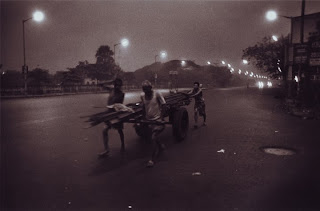
(Dawn, Calcutta - Don McCullin)


Through his career Don McCullin has been at the forefront of most of the conflicts around the world after WWII. He is not gun-ho about his experiences, not complacent in seeing the suffering humankind inflicts on each other. His photography reflects both the physical as well as personal destruction experienced through warfare. Though he has shot many other locations than warzones (as seen from the picture above) he is best remembered for the personal and harrowing pictures of war from the last 50 years.

As part of the BBC Today programme the BBC have released a short photography slideshow voiced by McCullin. It is short but powerful and like his work, McCullin's commentary leaves a lasting impact.


There is also an interview with Don McCullin in the BBC's radio archive. Follow the links below. Be warned the slideshow contains disturbing imagry.


http://www.bbc.co.uk/radio3/johntusainterview/mccullin_transcript.shtml for a transcript of an inteview with BBC radio 3

Wednesday, 3 February 2010

The LGBT History Series (3) - Joe Orton

Today's blog is about the Leicester-born and bred playwrite, Joe Orton (1933-1967).
Joe Orton could be seen as a teenager defacing library books in the City Library, (which are now part of the Joe Orton Special Collection, available for viewing at the David Wilson Library) but had a strong interest in performing arts, body-building and elocution and got accepted on scholarship to RADA in 1950.

Before he left for London, I'm reliably informed that Orton had his first homosexual experience in the toilets of the Athena (then the Odeon), just across the way from today's 'Curve'. I for one am waiting for the blue plaque and the Scheduled Monument status in that toilet. During his study at RADA he met his partner Kenneth Halliwell and they moved into a flat in London. 17 years later, the chauffeur picking Orton up for a meeting with the Beatles about a screenplay would discover Orton's and Halliwell's bodies in the flat after a murder-suicide when Orton admitted to having another boyfriend.

But in the meantime, Joe Orton had a career writing outrageously macabre comedy plays of varying success. Plays to note include 'Entertaining Mr Sloane', 'Loot', and 'What the Butler Saw'.

Various editions of Orton's diaries can be found in the University Library and the City Library (which fortunately now celebrates him, despite the whole book-defacing thing), his plays are still popular (LUT performed 'Loot' in 2008), and his life has been made into a film starring Gary Oldman as Joe Orton.

New Resource: British Cartoon Archive

I've always enjoyed looking at old jokes, and found the prospect of sharing a joke down the ages to be a rather appealing one. A new resource can help you do this, and will be useful for both teaching and research alike.

The British Cartoon Archive, at the University of Kent at Canterbury, is a national collection devoted to the history of British cartooning over the last two hundred years. It consists of cartoons of political and social comment published in British newspapers and magazines, and holds over 150,000 pieces of cartoon artwork by over 350 cartoonists, plus 85,000 newspaper cuttings. The digitised element of the collection includes the Carl Giles Archive.

Text from library website. For more details or to access the site, please visit the library page.

How to write history

Friday's lab was amongst our best, and certainly amongst our most useful. A very big thank you to Paul for coming and giving us his distilled wisdom. Here is your homework, with some handy reference volumes and some essential reading from fine historians.

Someone asked for a list of recommended reading. Here it is:
For style: The Elements of Style by William Strunk and E.B. White (Longman; widely available).
The Economist Style Guide (Profile Books; widely available). [I am reliably informed that the second-hand bookshop in the Students' Union has copies of this available - Ed.]
George Orwell's classic: Politics and the English Language (1946) in many compilations, or here http://www.resort.com/~prime8/Orwell/patee.html

For exemplars of good writing by contemporary historians see:
Anything by David Starkey, Tom Holland, Mary Beard, Antony Beevor, AJP Taylor, EP Thompson.
The Inheritance of Rome by Chris Wickham (newly released in Penguin paperback)
A World by Itself, edited by Jonathan Clark (Heinemann)
Island Stories by Raphael Samuel (Verso)
And, of course, History Today!

Tuesday, 2 February 2010

The LGBT History Series (2) Hall-Carpenter Archives

I thought we'd kick the series off with an incredibly useful tool for historical research.

The Hall-Carpenter Archives, named after Marguerite Radclyffe Hall and Edward Carpenter, are based in the London School of Economics, and make up a collaboration of collections, the biggest three being 'The Hall-Carpenter Main Collection' in the LSE Library, 'The Lesbian and Gay News and Media Archive' at Middlesex University, and 'The HCA Oral History Collection' which is part of the British Library.

Also of note is the Press Cuttings Collection, which moved in 1990 to the Greenwich Lesbian and Gay Centre.

I'd urge you to take a look at the website and any other material you can find because this archive is a valuable resource that not nearly enough people have heard of!

Watch this space for the rest of the series of interesting, inciteful, entertaining and thought-provoking blogs on LGBT History.

Monday, 1 February 2010

The LGBT History Series (1)

Ladies and Gentlefolks,

It is my most exciting pleasure to announce and introduce a series of blogs dedicated to LGBT History Month 2010 (which starts today).

The format goes kind of the same as our blog-based Advent calendar (see December's posts), only in February and covering matters queer and historical.

Naturally, our most anticipated day on the calendar will be the 26th February, where Dr David Clark and Dr Holly Furneaux present a seminar called 'Queer Histories', covering intimacy between Medieval men, and a re-analysis of Dickens' characters from a queer persepective. Proceedings will take place in the usual place, at the usual time, with the usual tea and cake, and the usual trip to the pub afterwards. (1 Salisbury Road, 4:30pm, generic tea brand, Malcolm's tiffin probably, The Marquis of Wellington), see you there!

Boundaries transcended

Well what a day! A good number of labbers were present yesterday for the New History Lab's first annual postgraduate workshop 'Transcending the Boundaries'. We had a series of brilliant papers and some excellent discussion. Thanks so much to the attendees, paper-givers and helpers. With the assistance of the Beyond Distance Research Alliance and Colin Hyde (EMOHA), we'll be posting podcasts to this blog in the near future. Jenny, from Museum Studies dutifully blogged the proceedings, and you can read her notes on here too.

There might just be one next year, so comments and feedback to [email protected] are very welcome. Perhaps Boundaries Regained could be the title?