
Well, chaps, that's me done for tonight. While I'll do a proper round up later, I'd just like to thank the New History Lab for welcoming me to the blog, and for providing what was a fascinating and busy day. We're off to the Guildhall for refreshments (sorely needed) and a tour now, from which I really don't think I can blog.
But thank you all. I'm very, very grateful to you for brightening up my Saturday!
Saturday, 30 January 2010

Using Material Culture to Recreate Early Mordern Kinship Networks and Political Alliences
Cathryn Enis, 'Sources, Controversies, and Rediscovering Affective Significance'
In her research into relationships in Elizabethan gentry in Warwickshire, Cathryn has had to use material culture as evidence, rather than as illustration - an infact, she considers it a vital part of building a rich picture of identities and kinships. It is not just the traditional document that can be read as historical resource.
There are limits to what a document can represent. They may well be a rich resource of information, but they are always open to interpretation and they always leave out much. It may well be that standardised documents, such as wills as Cathryn illustrates, may tell us as much about generalised convention as about particularity and individual relationships.
The relationship which people have with material culture itself might be used to illuminate meanings that lie behind their documented use and giving of it. Objects are not simple things - rather, they are symbols, recognition of which a purely factual reading of documentation cannot always provide. Much as is the case with Shakespeare's bequest to his wife of the 'second best bed'.
Kinship networks are very poorly represented in traditional documentary sources. Business transactions can provide information about contact, but are more difficult to read as evidence of personal affiliation. In the case of John Throckmorton, personal alliences are depicted in the crests built into his stained glass at Coughton Court.
The Sheldon Tapestry Map of Warwickshire is a particularly interesting case. Generally the motivation for their construction has been little studied. The map is, for some reason, turned on its side, and currently is not on display. Access to the other maps is somewhat difficult, as there is some dispute about provenance. Important material evidence is frequently only intermittently available.
15 gentry residences are depicted on the map - the decision to include them cannot be arbitrary. How do all the residences fit together? How were they intended to been seen? As family alliences, as political alliances, as evidence of religious affiliation? They are difficult to read, but sometimes this is a risk that has to be taken if we are to make connections and build up our own tapestries of knowledge.
Warwickshire was a complicated county. A diverse county. A politically and culturally important county. It's 16th century history has often been left behind, due partly to the Free Libraries Fire at Birmingham in which much of the documentation was lost. But it is surely not valid to ignore it because of this. Material culture has value - some would say it has an active agency in establishing political and social power.
Language is a symbol, after all. One of many which we use. We all have items which we have attached value and meaning to. Sometimes these meanings cannot be symbolised in words. Only by connecting the representations can we hope to come to our fullest possible understanding of ourselves.
In her research into relationships in Elizabethan gentry in Warwickshire, Cathryn has had to use material culture as evidence, rather than as illustration - an infact, she considers it a vital part of building a rich picture of identities and kinships. It is not just the traditional document that can be read as historical resource.
There are limits to what a document can represent. They may well be a rich resource of information, but they are always open to interpretation and they always leave out much. It may well be that standardised documents, such as wills as Cathryn illustrates, may tell us as much about generalised convention as about particularity and individual relationships.
The relationship which people have with material culture itself might be used to illuminate meanings that lie behind their documented use and giving of it. Objects are not simple things - rather, they are symbols, recognition of which a purely factual reading of documentation cannot always provide. Much as is the case with Shakespeare's bequest to his wife of the 'second best bed'.
Kinship networks are very poorly represented in traditional documentary sources. Business transactions can provide information about contact, but are more difficult to read as evidence of personal affiliation. In the case of John Throckmorton, personal alliences are depicted in the crests built into his stained glass at Coughton Court.
The Sheldon Tapestry Map of Warwickshire is a particularly interesting case. Generally the motivation for their construction has been little studied. The map is, for some reason, turned on its side, and currently is not on display. Access to the other maps is somewhat difficult, as there is some dispute about provenance. Important material evidence is frequently only intermittently available.
15 gentry residences are depicted on the map - the decision to include them cannot be arbitrary. How do all the residences fit together? How were they intended to been seen? As family alliences, as political alliances, as evidence of religious affiliation? They are difficult to read, but sometimes this is a risk that has to be taken if we are to make connections and build up our own tapestries of knowledge.
Warwickshire was a complicated county. A diverse county. A politically and culturally important county. It's 16th century history has often been left behind, due partly to the Free Libraries Fire at Birmingham in which much of the documentation was lost. But it is surely not valid to ignore it because of this. Material culture has value - some would say it has an active agency in establishing political and social power.
Language is a symbol, after all. One of many which we use. We all have items which we have attached value and meaning to. Sometimes these meanings cannot be symbolised in words. Only by connecting the representations can we hope to come to our fullest possible understanding of ourselves.
"Sisters Are Doing It For Themselves..."
Caroline Mogg, 'Reconstructing the Unmarried Woman in Nineteenth Century England'
Beginning as a geographer led Caroline to an interest in social history, especially women's history. While there have been studies of the women of the labouring classes, the case of the middle class women has been rather theorised in the confines of hearth and home, and related to a man's world. The single middle class woman was, and often still is, considered in many ways socially impoverished or even a threat. By adopting this 'spinster discourse', history has excluded the idea that these unmarried women may actually have seen themselves, and been seen in practical terms, as a valuable, powerful and autonomous members of society.
What are the different conceptual approaches which can be used to understand the women and to challenge the traditional construction of the unmarried women? This is the question which Caroline aims to address. Approaches to the subject have not really considered the self representation of the women in terms of their commercial correspondence, concentrating rather upon the homlier texts of diaries and letters. By doing so, we deny these women their position and identity as people of independent means.
It is also the method in which you read letters and texts that is open to debate. Reading just the texts, rather than the lines between, and the other tangible and intangible traces of the author's emotional and social world, leaves us with dry bleak history. Personally, I maintain that the use of documentary evidence is often very poor and limited. By attempting to elevate them to the status of documents of ultimate truth, we actually deny them their fullest and richest existence as subjective items. If we read them as objects, as art, as literature, in other words as other than factual, we can open doors onto whole new levels of speculation and storytelling. And in the end, isn't that what we historians do - tell stories?
Beginning as a geographer led Caroline to an interest in social history, especially women's history. While there have been studies of the women of the labouring classes, the case of the middle class women has been rather theorised in the confines of hearth and home, and related to a man's world. The single middle class woman was, and often still is, considered in many ways socially impoverished or even a threat. By adopting this 'spinster discourse', history has excluded the idea that these unmarried women may actually have seen themselves, and been seen in practical terms, as a valuable, powerful and autonomous members of society.
What are the different conceptual approaches which can be used to understand the women and to challenge the traditional construction of the unmarried women? This is the question which Caroline aims to address. Approaches to the subject have not really considered the self representation of the women in terms of their commercial correspondence, concentrating rather upon the homlier texts of diaries and letters. By doing so, we deny these women their position and identity as people of independent means.
It is also the method in which you read letters and texts that is open to debate. Reading just the texts, rather than the lines between, and the other tangible and intangible traces of the author's emotional and social world, leaves us with dry bleak history. Personally, I maintain that the use of documentary evidence is often very poor and limited. By attempting to elevate them to the status of documents of ultimate truth, we actually deny them their fullest and richest existence as subjective items. If we read them as objects, as art, as literature, in other words as other than factual, we can open doors onto whole new levels of speculation and storytelling. And in the end, isn't that what we historians do - tell stories?
The Plenary Speech
Joe Moran 'Interdisciplinarity: Problems and Possibilities'
Having graduated from a 'rather dry' first degree in history, he decided to do a masters course in English. At 1991, he ended up in Sussex, which at that time had a hugely high powered and 'glamourous' interest in theory. Moving into American Studies showed him a different model of interdisciplinarity, which was more grounded and local than the English department.
He realised that he wanted to apply this grounded approach to his own country, and while he still teaches American Studies, his publications and links have enabled him to establish thematic courses which cross the boundaries between literature, cultural theory and history.
He doesn't consider his work 'theorised' interdisciplinarity, but he does see his work as naturally eclectic. He hasn't made what you might term an intellectual commitment to the rather strange idea of a discipline of interdisciplinarity, rather, he considers himself accidentally interdisciplinary. It is just what he is.
His book, Interdisciplinarity, argues that people have used the term without really thinking about what it means. Everyone knows why it is supposed to be a good thing, being able to de-ossify established hierarchies and transcend traditional exclusions and limitations.
Wikipedia has identified 42 (yes, the ultimate number) disciplines. It is ironic that a form that has been lauded and vilified for being the ultimate in 'hodgepodge' gives such a definitions.
But what does the term actually mean?
Disciplinarity refers both to a body of practice or knowledge, a recognised mode of learning, but also control. One of the earliest referals was 'The Discipline of the Secret'. The critique of the 'disciplines' for their exclusivity and boundedness is longstanding. But the term 'interdisciplinarity' was first used in the social sciences in the 1920s.
Partly, it is related to the search for a more generalised, all inclusive way to knowledge, but it also relates to what can be known, and the methods by which it can be found. In this, it relates to epistomology. The more evangelical mode of interdisciplinarity can be used to break down these boundaries and enclaves of study.
What is studied in universities is, as ever, a political problem. In recent years there has been a backlash against interdisciplinarity's claims to be more transgressive and inventive than other modes of thought. Bill Readings, in 'The University in Ruins' challenged the grandiose claims made by many proponents of interdisciplinarity. He suggested that it could be related to the market oriented university's aims of commercial growth and the quest for a rather nebulous idea of 'excellence'. Merging departments into interdisciplinary studies is related, in a North American context, to cost cutting and university administration.
Many have been concerned that a move straight into interdisciplinary work results in over eclectisism and an intellectual free for all. However, many of these critiques recognised the potential benefits of the idea - but they also recognised it's limitations. They seemed to consider that it represented the future of intellectualism, but recognised that individuals really needed to understand those disciplines that they were crossing.
The concerns of Reading and others are now being felt outside North American. Thomas Docharty, writing in the Times Higher, claims that interdisciplinarity can be traced back to the radical 1960s assumption that disciplines were hindering, blinkered, and needed breaking down. Interestingly, interdisciplinarity has now become part of the establishment. Strange, isn't it, how that happens? The desire to break down boundaries is not always about liberation. Revolutionary ideas have been appropriated for the advantages of the cultural denziens and those in power.
Current fashions for thematic 'sandpits', and interdisciplinary partnerships, especially amoung the research council can actually be rather limiting. There is, Docherty argues, nothing wrong with disciplinarity in itself. Interdisciplinarity has been appropriated for its own sake, not because of any external value. It's hard for an individual to be 'interdisciplinary'. There's a reason for the 'artifice' of the disciplinary model.
Stanley Fish has called for literary critics to become more disciplinary. These calls are now being made by less conservative people, such as the Marxist literary critic, Terry Eagleton.
Hardly any of the students that Joe has taught had learned the same kind of literary criticism that he did. They conduct content analyses - and what gets left out is the literary element. They do not write why poets choose to write in a form where the lines do not reach to the ends of the page. Eagleton blames, not interdisciplinarity itself, as much as Capitalism. If capitalism is a place in which 'all that is solid melts into air', we need more disciplinarity.
But many of these criticisms overestimate the decline of disciplines, Joe argues. This is espeicially apparent in this country, where centralised funding and the difficulty of getting a job without being located within a discipline. League tables, Research Excellence Frameworks, reviews and performance indicators reproduce and market recognised degrees and departments - and indeed are often controlled by individual disciplines. Peer review remains the most important form of recognition. In a competition to sell degrees to the undergraduate market, and the marketability of individuals to the graduate market depends very deeply upon specific, disciplinary, almost commercially recognised characteristics.
It is true that the research, especially theoretical, of departments spans disciplines. It is true that the technological advances of the recent years and the rise in the digital humanities has served to change ideas about the boundaries of disciplines. But disciplines still exist within these.
Interdisciplinary work still needs a home. It needs a place in which to site itself so that it can truly move beyond that. If you have no identity, you cannot combine with something else without becoming that thing. Identities are what make us individuals and surely, what makes us interdisciplinary is our ability to bring together and celebrate those differences for mutual benefit, without loosing that sense of the self.
Joe has a blog here!
Having graduated from a 'rather dry' first degree in history, he decided to do a masters course in English. At 1991, he ended up in Sussex, which at that time had a hugely high powered and 'glamourous' interest in theory. Moving into American Studies showed him a different model of interdisciplinarity, which was more grounded and local than the English department.
He realised that he wanted to apply this grounded approach to his own country, and while he still teaches American Studies, his publications and links have enabled him to establish thematic courses which cross the boundaries between literature, cultural theory and history.
He doesn't consider his work 'theorised' interdisciplinarity, but he does see his work as naturally eclectic. He hasn't made what you might term an intellectual commitment to the rather strange idea of a discipline of interdisciplinarity, rather, he considers himself accidentally interdisciplinary. It is just what he is.
His book, Interdisciplinarity, argues that people have used the term without really thinking about what it means. Everyone knows why it is supposed to be a good thing, being able to de-ossify established hierarchies and transcend traditional exclusions and limitations.
Wikipedia has identified 42 (yes, the ultimate number) disciplines. It is ironic that a form that has been lauded and vilified for being the ultimate in 'hodgepodge' gives such a definitions.
But what does the term actually mean?
Disciplinarity refers both to a body of practice or knowledge, a recognised mode of learning, but also control. One of the earliest referals was 'The Discipline of the Secret'. The critique of the 'disciplines' for their exclusivity and boundedness is longstanding. But the term 'interdisciplinarity' was first used in the social sciences in the 1920s.
Partly, it is related to the search for a more generalised, all inclusive way to knowledge, but it also relates to what can be known, and the methods by which it can be found. In this, it relates to epistomology. The more evangelical mode of interdisciplinarity can be used to break down these boundaries and enclaves of study.
What is studied in universities is, as ever, a political problem. In recent years there has been a backlash against interdisciplinarity's claims to be more transgressive and inventive than other modes of thought. Bill Readings, in 'The University in Ruins' challenged the grandiose claims made by many proponents of interdisciplinarity. He suggested that it could be related to the market oriented university's aims of commercial growth and the quest for a rather nebulous idea of 'excellence'. Merging departments into interdisciplinary studies is related, in a North American context, to cost cutting and university administration.
Many have been concerned that a move straight into interdisciplinary work results in over eclectisism and an intellectual free for all. However, many of these critiques recognised the potential benefits of the idea - but they also recognised it's limitations. They seemed to consider that it represented the future of intellectualism, but recognised that individuals really needed to understand those disciplines that they were crossing.
The concerns of Reading and others are now being felt outside North American. Thomas Docharty, writing in the Times Higher, claims that interdisciplinarity can be traced back to the radical 1960s assumption that disciplines were hindering, blinkered, and needed breaking down. Interestingly, interdisciplinarity has now become part of the establishment. Strange, isn't it, how that happens? The desire to break down boundaries is not always about liberation. Revolutionary ideas have been appropriated for the advantages of the cultural denziens and those in power.
Current fashions for thematic 'sandpits', and interdisciplinary partnerships, especially amoung the research council can actually be rather limiting. There is, Docherty argues, nothing wrong with disciplinarity in itself. Interdisciplinarity has been appropriated for its own sake, not because of any external value. It's hard for an individual to be 'interdisciplinary'. There's a reason for the 'artifice' of the disciplinary model.
Stanley Fish has called for literary critics to become more disciplinary. These calls are now being made by less conservative people, such as the Marxist literary critic, Terry Eagleton.
Hardly any of the students that Joe has taught had learned the same kind of literary criticism that he did. They conduct content analyses - and what gets left out is the literary element. They do not write why poets choose to write in a form where the lines do not reach to the ends of the page. Eagleton blames, not interdisciplinarity itself, as much as Capitalism. If capitalism is a place in which 'all that is solid melts into air', we need more disciplinarity.
But many of these criticisms overestimate the decline of disciplines, Joe argues. This is espeicially apparent in this country, where centralised funding and the difficulty of getting a job without being located within a discipline. League tables, Research Excellence Frameworks, reviews and performance indicators reproduce and market recognised degrees and departments - and indeed are often controlled by individual disciplines. Peer review remains the most important form of recognition. In a competition to sell degrees to the undergraduate market, and the marketability of individuals to the graduate market depends very deeply upon specific, disciplinary, almost commercially recognised characteristics.
It is true that the research, especially theoretical, of departments spans disciplines. It is true that the technological advances of the recent years and the rise in the digital humanities has served to change ideas about the boundaries of disciplines. But disciplines still exist within these.
Interdisciplinary work still needs a home. It needs a place in which to site itself so that it can truly move beyond that. If you have no identity, you cannot combine with something else without becoming that thing. Identities are what make us individuals and surely, what makes us interdisciplinary is our ability to bring together and celebrate those differences for mutual benefit, without loosing that sense of the self.
Joe has a blog here!
"The Area Told as A Story"
Oyvind Eide 'An Inquiry into the Relationship Between Verbal and Map-Based Expressions of Geographical Information'
From the Centre for Computing for the Humanities at KCL, Oyvind has to bring in many different different disciplines to answer his questions about how people understand and represent geography and geographical identity.
The Notaricus Publicus of medieval Marseille, a document regarding land ownership, which discussed much about landscape never once used a map. The Sami used orally chanted representations of geography for spiritual and cultural means, but not as navigational devices. Why? Using theory, historical research and computer based models of the sources, Oyvind intends to investigate the reasons behind the different ways in which people have thought about the landscape and how they have represented it, and situated themselves within it.
Firstly, what is the difference between a geographical text and a geographical map? Is it connected to the semiotics, the meanings of a document, or is it to do with the methods of reading? There is some argument for both - the objects themselves might remain fixed, and their meanings might always exist, but where those meanings lie and how they are manifest is also very much to do with the audiences' engagement with it.
Given that a map is an image and a geographical text is...well, a text...Oyvind turned to a comparison of painting and poetry. The work of Lessing was key to this. What we can really learn from this is that both forms have their advantages - there are certain things that one or the other of them does not provide which the other does. It just shows you that you cannot rely on only one source of information. But he does suggest that while a text can explain all that a map can, a map cannot explain all that a text can.
One of the interesting historical points is that in many cases where landscape information is gathered, the people it is gathered from are considered valuable for their knowledge, not for their status. These sources of geographical information may be hugely varied in terms of their social status, ethnic group, type of work and geographical associations. How the information was collected is also particularly interesting - who was collecting, for what reasons and how. It is this kind of information that can perhaps be more easily expressed in a text.
Nonetheless, I do feel that there is value in maps beyond this. As cultural and historical artefacts, as symbols of social status, social conditions, as representations of belief, as art, they are extremely valuable sources. They served different uses to different people at different times. We retain many of these methods of understanding - Oyvind, interestingly, links the medieval practice of telling stories through images to modern graphic novels. Forms of understanding are not always textual, and people do not operate always in a textual manner. In terms of how people formulate their sense of self and place, no source should ever be discounted - but neither should it be taken as the only route to knowledge. As technology changes, as Google Streetview changes our ideas of the map as media, and as augmented realities arise, these questions of source differences become increasingly vital and difficult.
From the Centre for Computing for the Humanities at KCL, Oyvind has to bring in many different different disciplines to answer his questions about how people understand and represent geography and geographical identity.
The Notaricus Publicus of medieval Marseille, a document regarding land ownership, which discussed much about landscape never once used a map. The Sami used orally chanted representations of geography for spiritual and cultural means, but not as navigational devices. Why? Using theory, historical research and computer based models of the sources, Oyvind intends to investigate the reasons behind the different ways in which people have thought about the landscape and how they have represented it, and situated themselves within it.
Firstly, what is the difference between a geographical text and a geographical map? Is it connected to the semiotics, the meanings of a document, or is it to do with the methods of reading? There is some argument for both - the objects themselves might remain fixed, and their meanings might always exist, but where those meanings lie and how they are manifest is also very much to do with the audiences' engagement with it.
Given that a map is an image and a geographical text is...well, a text...Oyvind turned to a comparison of painting and poetry. The work of Lessing was key to this. What we can really learn from this is that both forms have their advantages - there are certain things that one or the other of them does not provide which the other does. It just shows you that you cannot rely on only one source of information. But he does suggest that while a text can explain all that a map can, a map cannot explain all that a text can.
One of the interesting historical points is that in many cases where landscape information is gathered, the people it is gathered from are considered valuable for their knowledge, not for their status. These sources of geographical information may be hugely varied in terms of their social status, ethnic group, type of work and geographical associations. How the information was collected is also particularly interesting - who was collecting, for what reasons and how. It is this kind of information that can perhaps be more easily expressed in a text.
Nonetheless, I do feel that there is value in maps beyond this. As cultural and historical artefacts, as symbols of social status, social conditions, as representations of belief, as art, they are extremely valuable sources. They served different uses to different people at different times. We retain many of these methods of understanding - Oyvind, interestingly, links the medieval practice of telling stories through images to modern graphic novels. Forms of understanding are not always textual, and people do not operate always in a textual manner. In terms of how people formulate their sense of self and place, no source should ever be discounted - but neither should it be taken as the only route to knowledge. As technology changes, as Google Streetview changes our ideas of the map as media, and as augmented realities arise, these questions of source differences become increasingly vital and difficult.
Applying Contemporary Criminological Theory to HIstorical Research
Amy Burrell 'Applying Contemporary Criminological Theory to Historical Research'
Visiting from the School of Psychology, Amy presents her research into serial robbery, and how you might be able to link offences together based on behavioral consistency. Interesting for the historical researcher in many ways, I would think.
A number of criminological theories are discussed. The "Opportunity Theory" is perhaps the simplest. If the opportunities occur, crime will rise. Consistency in patterns of theft and crime is clearly related to geographical and contextual contingencies. Street sex workers are more likely to be murdered than women who don't. They are available - and they make themselves so.
Routine Activity Theory builds on this, positing that there are particular situations that create those opportunities. You need a motivated offender, a suitable victim and the lack of guardianship. It also talks about awareness space - that we are more likely to see crime opportunities in the places and spaces with which we are familiar.
The Rational Choice Theory assumes that offenders are seeking benefit from their crime, portraying them as active decision makers.
The CRAVED model suggests that there has to be some kind of value to an item that might be stolen. They must be concealable, removable, available, valuable, enjoyable and disposable.
Such modes of enquiry might well be applied to gain a deeper understanding of historical actions and perhaps to establish behavioral consistency for individuals, whose roles in events around them may be subject to debate. The patterns of violence inflicted upon the 5 victims who have been officially recognised as related to Jack the Ripper, the geographical location, the time frame, and the nature of the work of the women, have all been shown to have a level of consistency which doesn't quite apply to the other possibilities, of which there were at least 13. Certain behaviors - in the case of Jack the Ripper, the removal of organs, and in the case of the Suffolk Ripper the posing of the bodies - are very rare, and can almost act like identity tags. Using the 'Consistency Hypothesis' might well be useful for establishing historical characters and identity.
These issues are pertinent not only to the historical researcher, but to the cultural heritage protection sector. Identifying the opportunities and the motivations that people may have for perpetrating crimes against cultural heritage - looting in war-torn and physically devastated areas springs to mind - and the patterns of behavior that certain individuals and organisations might exhibit, we can work to protect those items and institutions which are vulnerable, and work towards identifying the people responsible. Clearly, the motivations for crime change over time - the theft of the Mona Lisa from the Louvre in the early 20th century might well be less likely to occur now given the changed political circumstances and attitudes.
Visiting from the School of Psychology, Amy presents her research into serial robbery, and how you might be able to link offences together based on behavioral consistency. Interesting for the historical researcher in many ways, I would think.
A number of criminological theories are discussed. The "Opportunity Theory" is perhaps the simplest. If the opportunities occur, crime will rise. Consistency in patterns of theft and crime is clearly related to geographical and contextual contingencies. Street sex workers are more likely to be murdered than women who don't. They are available - and they make themselves so.
Routine Activity Theory builds on this, positing that there are particular situations that create those opportunities. You need a motivated offender, a suitable victim and the lack of guardianship. It also talks about awareness space - that we are more likely to see crime opportunities in the places and spaces with which we are familiar.
The Rational Choice Theory assumes that offenders are seeking benefit from their crime, portraying them as active decision makers.
The CRAVED model suggests that there has to be some kind of value to an item that might be stolen. They must be concealable, removable, available, valuable, enjoyable and disposable.
Such modes of enquiry might well be applied to gain a deeper understanding of historical actions and perhaps to establish behavioral consistency for individuals, whose roles in events around them may be subject to debate. The patterns of violence inflicted upon the 5 victims who have been officially recognised as related to Jack the Ripper, the geographical location, the time frame, and the nature of the work of the women, have all been shown to have a level of consistency which doesn't quite apply to the other possibilities, of which there were at least 13. Certain behaviors - in the case of Jack the Ripper, the removal of organs, and in the case of the Suffolk Ripper the posing of the bodies - are very rare, and can almost act like identity tags. Using the 'Consistency Hypothesis' might well be useful for establishing historical characters and identity.
These issues are pertinent not only to the historical researcher, but to the cultural heritage protection sector. Identifying the opportunities and the motivations that people may have for perpetrating crimes against cultural heritage - looting in war-torn and physically devastated areas springs to mind - and the patterns of behavior that certain individuals and organisations might exhibit, we can work to protect those items and institutions which are vulnerable, and work towards identifying the people responsible. Clearly, the motivations for crime change over time - the theft of the Mona Lisa from the Louvre in the early 20th century might well be less likely to occur now given the changed political circumstances and attitudes.
"Will the Real George Mellor Please Stand Up?"
William Marshall, 'The Depiction of West Ridding Luddism in Victorian Fiction'
In 1812, there was a rising of the Luddites in the West Riding of Yorkshire, and in 1813 there were executions. Were they political, or purely industrial in motive? They were certainly bloody. The complaints of the weavers, in response to increading industrialisation and the Napoleaonic Wars lead to machine destruction, violence and murder. These risings became mythic, and gained a great status in fiction in the 19th century - what was the motive for the persistant interest?
There was a ready made narrative, ready made characters, sitting there waiting to be molded according the the political motivations of the author. George Mellor became a great villain of Victorian fiction.
Shirley, by Charlotte Bronte, was published in 1849, was written from a middle class perspective. It was very much focussed on gender roles, and bore little relation to 'Sad Times', by Arthur Lodge, who wanted to show them as misguided, still violent, but a suffering sad group, whose living conditions were shocking, lead by unnamed leaders with wider political goals. There were many political commentaries in subsequent novels. There certainly was a lot of manipulation which went on, dependent upon the situations of the time and prevailing societal attitudes.
Particular characters usually appear in these situations. George Mellor is one of those who arose in the Luddite fictions. Under different names, perhaps, archetypes begin to appear, heroes and villains. We are always creating myths for our history - Robin Hood, the Green Man, Richard the III. We know, of course, that real people are never so one dimensional, but infrequently in such historical or political texts do people stand for people. Rather, they stand for ideas, for themes, for standpoints, for events.
It's fascinating to use literature as historical comment. I think that we fail to see the resource that it really is. We are very ready to read books as truth depending upon how it is presented - and this presentation begs the question as to the veracity of our reliance on sources deemed 'historical' and those considered 'fictional'. In a sense, all that we present is a fiction, a representation.
In 1812, there was a rising of the Luddites in the West Riding of Yorkshire, and in 1813 there were executions. Were they political, or purely industrial in motive? They were certainly bloody. The complaints of the weavers, in response to increading industrialisation and the Napoleaonic Wars lead to machine destruction, violence and murder. These risings became mythic, and gained a great status in fiction in the 19th century - what was the motive for the persistant interest?
There was a ready made narrative, ready made characters, sitting there waiting to be molded according the the political motivations of the author. George Mellor became a great villain of Victorian fiction.
Shirley, by Charlotte Bronte, was published in 1849, was written from a middle class perspective. It was very much focussed on gender roles, and bore little relation to 'Sad Times', by Arthur Lodge, who wanted to show them as misguided, still violent, but a suffering sad group, whose living conditions were shocking, lead by unnamed leaders with wider political goals. There were many political commentaries in subsequent novels. There certainly was a lot of manipulation which went on, dependent upon the situations of the time and prevailing societal attitudes.
Particular characters usually appear in these situations. George Mellor is one of those who arose in the Luddite fictions. Under different names, perhaps, archetypes begin to appear, heroes and villains. We are always creating myths for our history - Robin Hood, the Green Man, Richard the III. We know, of course, that real people are never so one dimensional, but infrequently in such historical or political texts do people stand for people. Rather, they stand for ideas, for themes, for standpoints, for events.
It's fascinating to use literature as historical comment. I think that we fail to see the resource that it really is. We are very ready to read books as truth depending upon how it is presented - and this presentation begs the question as to the veracity of our reliance on sources deemed 'historical' and those considered 'fictional'. In a sense, all that we present is a fiction, a representation.
"It's Not Really Glamourous at All"
Gill Murray and Julie Ives 'Ordinary People and Regional Television in the Midlands'
Making use of MACE, the Media Archive for Central England, which holds one of the most comprehensive catalogues of Regional TV in the country. Both the presenters come back from different backgrounds - Gill from Urban History and Julie from the History of Art and Film.
The relationship between the audiences and makers of regional news and television is a complicated one - as it is with the newspapers. The regional calendar of local events was expected to be shown by the television. But they also needed to show what was extraordinary. The intent of this paper is to show how the companies attempted to keep the audience engaged, often by juxtaposition of the ordinary with the extraordinary.
Programmes such as Citizen 84 provide such interesting juxtapositions - weighty topics such as the comparison of life in the region in 1948 and 1984, the Data Protection Bill alongside the profile of Gerri Perry, an aspiring topless model from Birmingham. But there's something real about her, something "Not really glamorous at all". It was considered perfectly acceptable for a teatime audience - and the TV company even considers, explicitly, their role in her rise to fame. The emphasis, though, remains male. She's presented at a calendar shoot, as a sexualised object. She is presented, too, as a local phenomenon, who was heading to national stardom.
In 1986, 'Stoke in Bloom' was broadcast. This was a time of huge levels of unemployment in the old Potteries, and the documentary might be read as a morale boost for the area.
(As an aside, I'm particularly loving the spectacles in this clip!)
There's a surreal and rather sad segment in which the presenters talk to a busker dressed in a gorilla suit playing an accordian. He refuses to get involved in the 'Stoke in Bloom' celebrations, because it "Isn't worthwhile for him". There's a melancholy comment to be made here. In a programme which intended to celebrate the area, we can peer into a world of poverty and dissolusionment.
Watching these old clips is fascinating. Not only are they interesting visually, but like museum objects, there are many ways in which they can be read. By setting them in their various contexts, we can see that they take part in a wider dialogue with society. The advantage with television is, of course, that there is much contextual information available, which for many objects and resources is not the case. Exploring such items collaboratively is a way of delving deeply into the richness of these items.
Resources need to be combined. We can, of course, only ever gain a limited picture of historical activities. But we can't ever find 'truth'. Just a window onto speculation and stories. But for all that, it's a worthwhile activity. It's important that we keep these records, much as we keep myths - they are part of our identity, part of our very selves.
Making use of MACE, the Media Archive for Central England, which holds one of the most comprehensive catalogues of Regional TV in the country. Both the presenters come back from different backgrounds - Gill from Urban History and Julie from the History of Art and Film.
The relationship between the audiences and makers of regional news and television is a complicated one - as it is with the newspapers. The regional calendar of local events was expected to be shown by the television. But they also needed to show what was extraordinary. The intent of this paper is to show how the companies attempted to keep the audience engaged, often by juxtaposition of the ordinary with the extraordinary.
Programmes such as Citizen 84 provide such interesting juxtapositions - weighty topics such as the comparison of life in the region in 1948 and 1984, the Data Protection Bill alongside the profile of Gerri Perry, an aspiring topless model from Birmingham. But there's something real about her, something "Not really glamorous at all". It was considered perfectly acceptable for a teatime audience - and the TV company even considers, explicitly, their role in her rise to fame. The emphasis, though, remains male. She's presented at a calendar shoot, as a sexualised object. She is presented, too, as a local phenomenon, who was heading to national stardom.
In 1986, 'Stoke in Bloom' was broadcast. This was a time of huge levels of unemployment in the old Potteries, and the documentary might be read as a morale boost for the area.
(As an aside, I'm particularly loving the spectacles in this clip!)
There's a surreal and rather sad segment in which the presenters talk to a busker dressed in a gorilla suit playing an accordian. He refuses to get involved in the 'Stoke in Bloom' celebrations, because it "Isn't worthwhile for him". There's a melancholy comment to be made here. In a programme which intended to celebrate the area, we can peer into a world of poverty and dissolusionment.
Watching these old clips is fascinating. Not only are they interesting visually, but like museum objects, there are many ways in which they can be read. By setting them in their various contexts, we can see that they take part in a wider dialogue with society. The advantage with television is, of course, that there is much contextual information available, which for many objects and resources is not the case. Exploring such items collaboratively is a way of delving deeply into the richness of these items.
Resources need to be combined. We can, of course, only ever gain a limited picture of historical activities. But we can't ever find 'truth'. Just a window onto speculation and stories. But for all that, it's a worthwhile activity. It's important that we keep these records, much as we keep myths - they are part of our identity, part of our very selves.
Using Replicant Technology as an Aid to Understanding Television History
Paul Marshall "Using replicant technology as an aid to understanding television history"
Paul Marshall is a full time engineer in the flight simulation industry and is a part time PhD student at Manchester University studying the origins of electronic television. He's a busy guy! At the end, he'd like to open some sort of museum to showcase his vintage broadcast collection.
The first use of the word 'television' was actually in 1900 - it means 'seeing into the distance', an idea which stretches back into antiquity. In a way. museums see into the distance - both past and future. Both televisions and museums allow us to see parts of the world we couldn't experience physically.
And like museums, the history of television is particularly political. Different nations and different corporations raise up different individuals as champions and originators of the medium. It's hard to find out the truth, and it's hard to find out what the precise nature of the television system used actually was. Which is where the replicant technology comes in.
From the late 1920s, we'd had an electromechanical television system. With twelve images per second, it was flickery and dim. Something else was needed.
Particularly in the US, a large amount of money began to be put into electronic television - given that this was in the time of the Great Depression, they must have been confident. In the UK, the BBC had been criticised for the original Baird System. There were two companies working on electronic television - Baird's, ironically, and EMI-Marconi. It was these systems which competed in what might be termed "The 1936 British Television Standards Competition".
This was set up by the Government. Paul shows us both the systems, on monitors from the 1970s. Baird's system of 240 lines flickers a lot more, but was a massive leap and had a number of advantages over the EMI-Marconi system. Nonetheless, EMI-Marconi was declared by the government and BBC to be the winner- they did have vested interests, and ever since then, there has been a narrative which suggests the inevitablity of this result. But need this have been the case. The EMI-Marconi system was really not as good as it was painted at the time.
Just goes to show that history very often shows only the winners.
Interestingly, electromechanical television didn't die. A company called Scophony continued to make them - but none survive. Paul would like to make one one day. Perhaps...and don't adjust your set...
Paul Marshall is a full time engineer in the flight simulation industry and is a part time PhD student at Manchester University studying the origins of electronic television. He's a busy guy! At the end, he'd like to open some sort of museum to showcase his vintage broadcast collection.
The first use of the word 'television' was actually in 1900 - it means 'seeing into the distance', an idea which stretches back into antiquity. In a way. museums see into the distance - both past and future. Both televisions and museums allow us to see parts of the world we couldn't experience physically.
And like museums, the history of television is particularly political. Different nations and different corporations raise up different individuals as champions and originators of the medium. It's hard to find out the truth, and it's hard to find out what the precise nature of the television system used actually was. Which is where the replicant technology comes in.
From the late 1920s, we'd had an electromechanical television system. With twelve images per second, it was flickery and dim. Something else was needed.
Particularly in the US, a large amount of money began to be put into electronic television - given that this was in the time of the Great Depression, they must have been confident. In the UK, the BBC had been criticised for the original Baird System. There were two companies working on electronic television - Baird's, ironically, and EMI-Marconi. It was these systems which competed in what might be termed "The 1936 British Television Standards Competition".
This was set up by the Government. Paul shows us both the systems, on monitors from the 1970s. Baird's system of 240 lines flickers a lot more, but was a massive leap and had a number of advantages over the EMI-Marconi system. Nonetheless, EMI-Marconi was declared by the government and BBC to be the winner- they did have vested interests, and ever since then, there has been a narrative which suggests the inevitablity of this result. But need this have been the case. The EMI-Marconi system was really not as good as it was painted at the time.
Just goes to show that history very often shows only the winners.
Interestingly, electromechanical television didn't die. A company called Scophony continued to make them - but none survive. Paul would like to make one one day. Perhaps...and don't adjust your set...
What is the value of "Interdisciplinarity"?
"Interdisciplinarity", according to Rob Colls, has been somewhat misused. It isn't about falsely fixing together departments and subjects for the sake of it. It's about the way you live your life. Your life is interdisciplinary, but you don't think about it. You don't differentiate between physics and literature in day to day existence. That's how you have to come to understand it. Interdisciplinarity happens in your head, not in faculties. It's in the familiar made extraordinary. So, Rob recommends, don't talk about it, DO it.
Things to think about, I think. Come to your subject with a broad mindset. Don't ignore any possibilities. For us at the Attic, that is something vitally important, Museum Studies being what it is. We work in a medium that is interdisciplinary. We work with Natural History and Human History, and Sociology and Anthropology. And sometimes, we don't think about it - and sometimes, we think about it too much.
Things to think about, I think. Come to your subject with a broad mindset. Don't ignore any possibilities. For us at the Attic, that is something vitally important, Museum Studies being what it is. We work in a medium that is interdisciplinary. We work with Natural History and Human History, and Sociology and Anthropology. And sometimes, we don't think about it - and sometimes, we think about it too much.
To begin at the beginning...
...It's Jenny here, your new blogger, direct and live from the Attic! I hope you're happy to see me - I'm happy to be here. We're all settled in Salisbury Road Houses just about ready to start Transcending The Boundaries. There are many to be transcended, it is sure. But I hope that we can start breaking down the boundaries today, and that we at the Attic can continue to do so!
Friday, 29 January 2010
Tory Training
Ahead of the NHL steam extravaganza on 20 March, who's been following Michael Portillo on the railways of Britain? Answer: Various irate ticket inspectors. ("Your advance ticket is not for this service; please purchase a standard open single at £520.")
He's following George Bradshaw's Victorian Railway Guidebook in cream chinos on weekday nights. The Tuesday night episode featured public parks in Derby and a visit to the home of Burton Bridge Bitter, a regular guest beer at the Marquis Wellington... so I'm told.
He's following George Bradshaw's Victorian Railway Guidebook in cream chinos on weekday nights. The Tuesday night episode featured public parks in Derby and a visit to the home of Burton Bridge Bitter, a regular guest beer at the Marquis Wellington... so I'm told.
Thursday, 28 January 2010
Protect and survive
It's very easy to demand that classical buildings ought to be listed to maintain their splendour. And fine, very old ones too (such as Leicester's grade-I listed guildhall wherein those registered for Transcending the Boundaries on Saturday shall have tea, cake and discussion on using the built environment as a source) demand care and resepct. I'm also increasingly convinced about the need to protect some of the striking excesses of 1960s architecture too - even brutalist visions in exposed, raw concrete - we might just change our mind and really like them, as we did with a lot of Victorian buildings. But silos and bunkers for American warheads? Apparently so. These chilling reminders of an even chillier chapter in history have been added (Guardian article here) to the Schedule of Historic Monuments, which is to historical sites what designation premier cru classé is to fine claret.
Largest Book in the World at the British Library
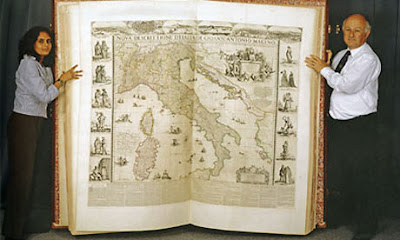 I just found this article via the British Library's Twitter page. The largest book in the world is going to be displayed at the BL over the summer.The book, which is the 350 year old Klencke Atlas presented to Charles II on his restoration, will be displayed in an exhibition on maps from 30 April to 19 September. You can read the whole article from the Guardian here.
Image from the Guardian
Wednesday, 27 January 2010
CFP: BAVS - Victorian Forms and Formations
The University of Glasgow, 2-4 September, 2010
The 2010 BAVS conference seeks to address the question of 'form', in all its varied meanings, in Victorian culture. We invite papers that address the topic of forms and formations across the disciplines, including but not limited to art history, science, architecture, politics, religion and history of the book. Papers might consider the role of different social and political groupings and institutions in the Victorian period, or the formation of a particular idea or discipline. They might deal with wide-ranging debates over varied attempts at reform in the nineteenth century, or could focus on the formation or reformation of the individual. Papers considering material forms, including the fashioning of the body in medical and other discourse, are welcome, as are papers on the physical features of the Victorian landscape: urban and rural spaces, natural forms and the built environment. We also invite papers that are concerned with the reworking of Victorian forms in twentieth and twenty-first century literature and culture.
A number of postgraduate bursaries will be available for postgraduate students presenting a paper at the conference or acting as a conference reporter. Please check this site in spring 2010 for details of how to apply.
Deadline for submission of abstract: 15 March 2010; please send a 200-word abstract to [email protected]
Further information is available at the conference website: http://www.gla.ac.uk/bavs/
Monday, 25 January 2010
A history of Delia Smith
Delia Smith's Book of Cakes has been central to the success of the New History Lab. The earliest cakes I made came from a slightly disintegrated old copy. The BBC have currently run a series of programmes on this national institution. The three episodes broadcast thus far are available on the iplayer (ep. 1; ep. 2; ep. 3). As a bonus, the whole thing is narrated by another venerable national institution, Stephen Fry. This is quite a few things in one. Firstly, it looks at Delia's cookery, with some yummy recipes. Secondly, it shows the changes in broadcasting. Perhaps the hints, however, at changing diets are the most interesting. The archive footage affords us glimpses. Ye olden Delia's suggestion that she rather enjoys a baked lasagna, is fascinating, as she points to the sheets of eggy goodness needed to make it. It's worth watching. It's history in the making too, as Delia's Complete Cookery Course will be read by historians in the future as we read Mrs Beeton today.
Subscribe to:
Posts (Atom)

 Posts
Posts



