Saturday, 12 December 2009

Advent 12: Hallaton Bottle Kicking


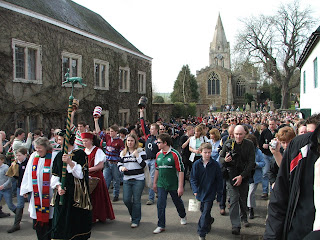
Each Easter Monday the villagers of Hallaton, Leicestershire, with assorted hangers on, meet to beat themselves up in an ancient ritual. The photo shows the moments after the vicar 'distributes' hare pie on the steps of the church (this actually means throwing it into the crowd indiscriminately) and the crowd turns towards the village green. On the left the master of ceremonies holds a staff with a hare on top of it, the three 'bottles' or barrels are carried aloft and later fought over; there is much noise and merriment. Two teams then assemble on a hill outside the village and engage in what seems like a rule free scrum which results in noise, injury and a winning team. All in all a fine example of traditional English rural madness.

Friday, 11 December 2009

Advent 11: Snibston


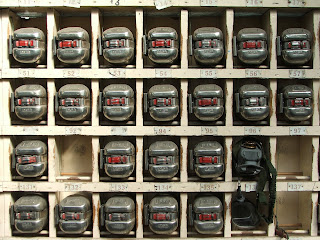
Broadly speaking the east side of Leicestershire is purely agricultural while the west side mixes agriculture with a number of extractive industries. In 1982 there were six coal pits operating in North West Leicestershire, employing 25% of the workforce and in some communities as much as 40-50% of the male workforce. By 1990 all the pits had been closed. Most visible signs of the coal mining industry in the area have disappeared under supermarkets and country parks - most as part of the National Forest - but the colliery at Snibston has been turned into a 'Discovery Museum' (as well as a country park). Indeed, Snibston has the largest fashion and costume display outside London and is the biggest interactive science, design and technology museum in the East Midlands. This photo from Snibston shows miners' artifical respirators, a vital part of the kit carried by all miners underground. For more information about the history of mining in the region, and Snibston itself, follow this link: http://www.leics.gov.uk/index/community/museums/snibston/snibston_about/snibston_history.htm

Thursday, 10 December 2009

History Fail

Sometimes I am overwhelmed by the real sense of history some people have, despite a clear lack of knowledge to back this up. The expectation that this wrong idea will support their political argument is remarkable. Have a look here and see.

Advent 10: Staunton Harold


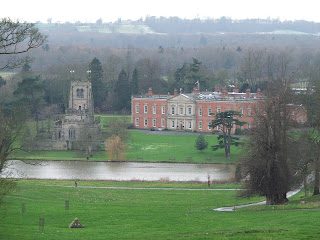
The Staunton Harold Estate is in N-W Leicestershire. The Shirley family built the 18th century house on the right, which includes earlier buildings, while the church is very special as it was built in 1653 during the Commonwealth.

Over the door of the church can be read: “In the year 1653 when all things sacred were throughout the nation either demolished or profaned, Sir Robert Shirley, Baronet founded this church; whose singular praise it is to have done the best things in the worst times and hoped them in the most calamitous. The righteous shall be had in everlasting remembrance.” For this, Sir Robert was sent to, and died in, the Tower of London.

The Shirley family parcelled up and sold the estate in 1954. The house was saved from demolition by Group Captain Lord Cheshire V.C to become one of his homes for the incurably sick, then became a Sue Ryder home, and is now a private residence. The stables are now the very popular Ferrers Centre for Arts & Crafts.

Wednesday, 9 December 2009

Advent 9: Southfields


The purchase by the Corporation from the Freemen of Leicester of the ancient South Field at the beginning of the 19th century enabled Leicester to expand southwards. This area, which stretched to the race course at Victoria Park, has always been best seen from the top of the hill where the University now stands. This photo is a montage - photographer unknown - which shows the view from the Charles Wilson building in the early 1970s. From left to right, the cooling towers have gone, the football ground has moved, the Royal Infirmary has expanded and the views to the left have been changed by new University buildings in the foreground. Click on the photo to see it at full size.

Tuesday, 8 December 2009

Advent 8: Colonel Cheney in Gaddesby Church


Gaddesby is a pretty village to the north east of Leicester. Inside Gaddesby's fine church, in the chancel, is this almost life-size albaster monument which shows Colonel Cheney on one of the four horses which were killed under him at the battle of Waterloo in 1815. Britains's churches contain some of the finest art of their time and, while none of the churches in Leicestershire & Rutlands rank with the very best, there are still many fine things to be seen. Other church photos will appear in this advent series, while photos of Gaddesby can be found here: http://www.le.ac.uk/emoha/leicester/gaddesby.html

Monday, 7 December 2009

Advent 7: Stoneywell Cottage


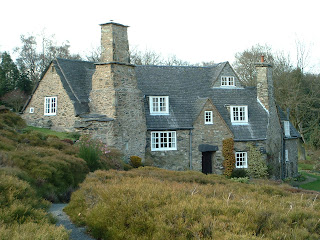
For those with an interest in the Arts and Crafts movement of the late 19th century, Ernest Gimson is a well known name. Gimson grew up in Leicester and, as well as his more celebrated skills as a designer and craftsman, he was an architect of some talent. In the City he created 'The White House' in Clarendon Park and 'Inglewood' in Knighton. In the County he built a number of houses for his family in and around Ulverscroft, not far from Bradgate Park. Pictured is Stoneywell Cottage, a lovely house built of, and on, the rocks of Charnwood Forest. To find out more about Gimson's life and work have a look at this Leicester Arts and Museum Service website: http://gimson.leicester.gov.uk/GimsonHome/

Sunday, 6 December 2009

Advent 6: the Hat and Beaver


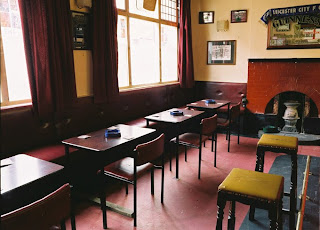
This is a photo of the front bar of the Hat and Beaver pub which used to stand on Highcross Street and was, until its closure last year, one of the last remaining 'unspoilt' city centre pubs. 'Semper Eadem', a joint project between photographer Maxine Beuret and the East Midlands Oral History Archive (EMOHA), has documented Leicester buildings whose interiors have remained unchanged for at least 25 years, and although the project was run during 2007/8 several of the buildings we chose have closed since then. Have a look at some of the other interiors recorded at http://www.sempereadem.org/ .