Saturday, 19 December 2009

Advent 19: Lee Circle


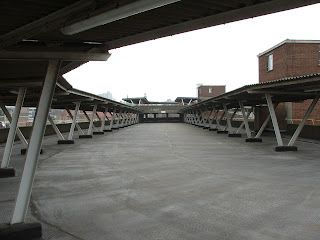
This picture shows the top level of the multi-story car park at Lee Circle. Built in the 1960s it and its fellow car parks which circle the city centre were an attempt to cope with the growing number of cars coming into Leicester. It is said to be the first automatic multi-storey car park in Europe and it housed, at the time, what was reputed to be the largest supermarket in the UK, the first Tesco outside London. It also hosted a bowling alley and for a short period Lee Circle was the place to be seen.

At the end of 2009 it is looking rather shabby and there have been calls to demolish it. However, there are also voices which wish to keep this monument to 1960s modernism and planning. Which should it be?

Friday, 18 December 2009

Advent 18: Jewry Wall


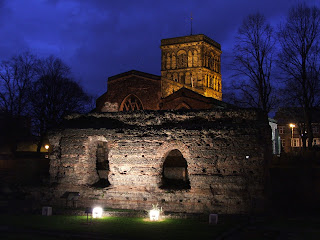
Lest we forget, Leicester is an ancient city which traces its history back before the Romans. Pictured above is the 'Jewry Wall', site of the Roman baths and now Vaughan College, and St Nicholas Church, a medieval church whose building materials include Roman bricks taken from the Jewry Wall (the name is not Roman but is possibly linked to the Medieval Jewish community in Leicester). One of the highlights of the recent opening of Leicester's new digital arts centre at Phoenix Square was the presentation of a new virtual walk through Roman Leicester which, when fully developed, will be interactive. Have a look here: http://news.bbc.co.uk/local/leicester/hi/people_and_places/arts_and_culture/newsid_8364000/8364238.stm

Thursday, 17 December 2009

Advent 17: Plaques (1)


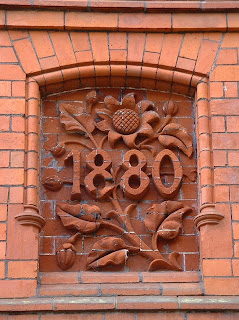
Both large and small Victorian houses were often decorated with plaques declaring either the date of construction, the name of the house, or both. The larger the house the greater scope there was for the elaborateness of the plaque. This example, from Princess Road East in Leicester, shows great artistry. The soft bricks have been rubbed to produce the detail and the appearance of a sunflower, a favourite motif of the 'Queen Anne' style, indicates a degree of modern taste and style which would be reflected in the architecture of the house and, possibly, the people living within. More brick and terracotta plaques can be seen here: http://www.le.ac.uk/emoha/leicester/terracotta.html

Wednesday, 16 December 2009

Advent 16: Green Men (2)


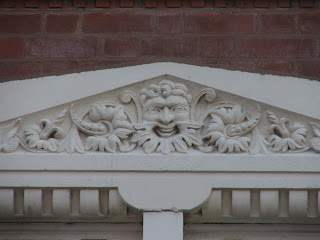
As we have seen previously, faces with foliage sprouting from them can be found in churches and cathedrals across the country. The Victorians used Green Men as decoration for secular buildings and examples are often found on banks, offices, etc. Sometimes faces can be found on larger private houses and it may be an attempt to copy this fashion which led to the decorated lintels above the doors and windows of humble terraced houses. The example shown here is on Guthlaxton Street, Leicester, and is a sort of 'King of the Fairies' figure. His queen is on the neighbouring window or door. For more examples and links to websites about the Green Man have a look here: http://www.le.ac.uk/emoha/leicester/greenmen.html

Tuesday, 15 December 2009

Advent 15: Sun Alliance


The Sun Alliance building is on Horsefair Street, on the north side of Town Hall Square. It is a late Victorian building and is part of a good group of mainly Victorian buildings which form a pleasant composition in the heart of Leicester. However, it is more than that...

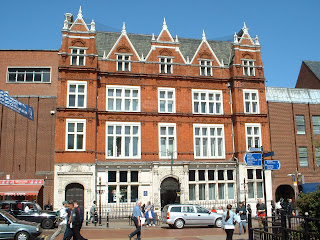
In the early 1970s the owners of the Sun Alliance wanted to replace it with a new building designed in a modern style. Leicester had already lost many of its historic buildings and the ensuing furore eventually contributed to Leicester's Chief Planning Officer, Konrad Smigielski, losing his job, while the reaction against this and the plans to build a multi-storey car park on Loseby Lane, led to the formation of Leicester's Civic Society. Nationally and locally there was a growing awareness of issues around the conservation of the built environment. As can be seen, the owners were forced to keep the Victorian facade and the preservation of this building now marks one of the points when the citizens of Leicester cried 'No more'!

Monday, 14 December 2009

Advent 14: The Market Square, North Evington


Arthur Wakerley was a Mayor of Leicester and an Alderman, and was celebrated as an architect, business man, and politician. In the 1920s he was the Chair of Leicester's first Housing and Town Planning Committee, as well as being a Weslyan local preacher, and President of the Temperance Union.

In the years around 1900, Wakerley perceived a need for good quality working class housing in Leicester, and to this end bought land comprising mainly brick pits and mud in the Spinney Hill/North Evington area. He set about creating a self-contained suburb which would provide everything its population required to work, rest and play. On Asfordby Street he built a market place with a hall, surgery, shops, and a police and fire station. Wakerley charged low prices for sites to encourage factories to the area, and by 1914 there were 28 factories employing over 5,000 people in 31 different trades.

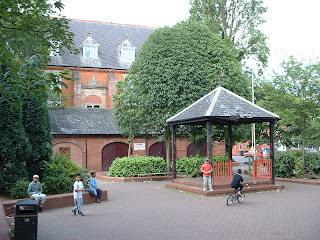
Unfortunately, the market was never a success; having become run down its market license was withdrawn in 1947, and it was only in 1982 that it was redeveloped by Rod Hackney & Associates as an open area with bandstand, as shown in the picture above. More on Wakerley and his vast contribution to Leicester at: http://www.le.ac.uk/emoha/leicester/wakerley.html

Sunday, 13 December 2009

Advent 13: Secular Hall


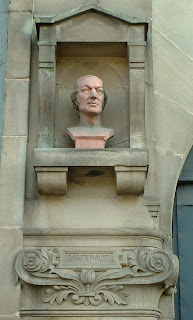
This bust of Robert Owen is one of five busts which adorn the front of Leicester's Secular Hall. Owen is known as the father of the co-operative movement and in 1839 he gave a series of four lectures in Leicester, supporting the already strong tradition of free thought in the town.

Leicester Secular Society was founded in 1851 and moved to the Secular Hall, Humberstone Gate, in 1881. The other busts on the Hall are Socrates, Jesus Christ, Voltaire, & Thomas Paine. To find out more about the Secular Society, the busts, the campaign to raise money for the Hall, and the list of upcoming speakers, have a look at their website: http://www.leicestersecularsociety.org.uk/

Poems based on entries from 'The Grasmere Journals'.


I based these poems on three December 1801 entries from 'The Grasmere Journals' by Dorothy Wordsworth. During this period, Dorothy Wordsworth, and her brother, the poet, William, lived at Dove Cottage in Grasmere. Dorothy was a poet in prose and her imaginative descriptions of the natural surroundings were a creative source for William's own poetry. Her journal entries also bear witness to the trials and tribulations of a harsh country life with accounts of hardship with particular concern shown for their friend, the poet Samuel Taylor Coleridge who wrote very melancholy letters describing his recent illness and affecting Dorothy and William's mood immensely. I include an entry to this effect after the poems.


Wednesday 9th

It was too dark to gather mosses
so we headed for Easedale;
saw Churn Milk force like a stream of snow.

The river came past at a gallop;
we walked backwards and forwards
till the shapes of the mountains disappeared.


Thursday 10th


We called at Aggy Fleming's
and shocking she looked with her hair tied up;
told us about her miserable house.
The children looked well, however,
and once again, not finding mosses,
went home to an evening of cards.


Saturday 12th

Helm Crag rose behind
the white marble ridge of mountains.

I thought of Coleridge,
his sickness, and just then
a bowl-shaped moon
flung itself through the clouds
above Silver-how
lighting up the roofs; the fields; the dark yew.


Monday 21st,
being the shortest day, Mary walked to Ambleside for letters, it was a wearisome walk for the snow lay deep upon the Roads and it was beginning to thaw> I stayed at home and clapped (ironed) the linen a. Wm sate beside me and read the Pedlar, he was in good spirits, and full of hope of what he should do with it. He went to meet Mary and they brought 4 letters, 2 from Coleridge, one from Sara and one from France. Coleridge's were very melancholy letters, he had been very ill in his bowels. We were made very unhappy......